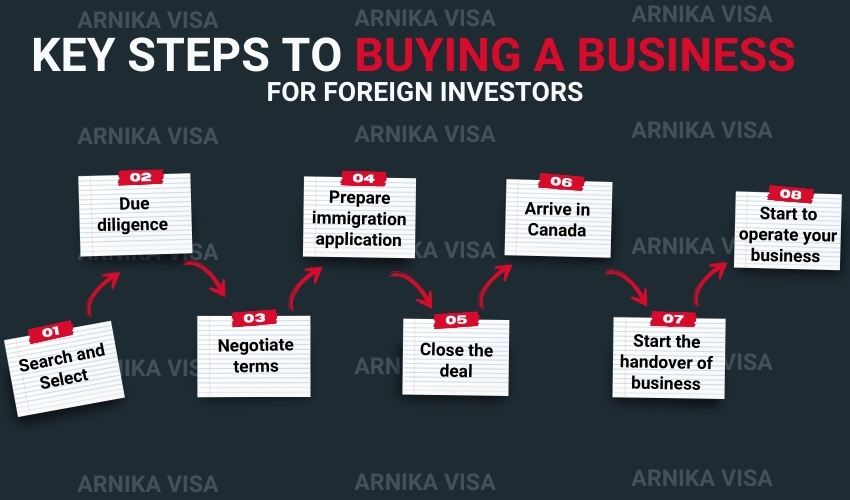

Buying an existing business in Canada can offer an entrepreneur access to an established customer base, employees, supplier relationships and operating history. But an acquisition also involves financial, legal, tax, operational and regulatory risks. A careful review before signing a binding agreement is essential.
Foreign buyers must consider an additional issue: the right to own or invest in a Canadian business is different from authorization to work in Canada. Buying shares or assets does not automatically give a buyer the right to relocate to Canada, manage the business in person or obtain permanent residence.
This guide explains how to assess an acquisition, conduct due diligence, value a business, negotiate the transaction and consider the immigration rules that may apply to a foreign buyer.
Last reviewed: November 2026
Can a Foreigner Buy a Business in Canada?
A non-Canadian may be able to acquire shares or assets of a Canadian business, but the transaction must be assessed under the laws that apply to the investor, target business, industry and transaction structure. Some sectors have ownership restrictions or licensing conditions. Foreign investments may also trigger requirements under the Investment Canada Act (ICA), including a notification or, for certain transactions, a pre-closing review.
The ICA can apply to the establishment of a new Canadian business and to the acquisition of control of an existing Canadian business, subject to statutory exemptions and requirements. National-security review can also apply to investments of any value. Do not assume that a transaction is exempt merely because the purchase price is modest.
Before signing or closing, review the applicable rules with qualified counsel and consult the Government of Canada’s Investment Canada Act information.
Foreign ownership also does not automatically authorize the owner to work in Canada. A buyer who intends to move to Canada and actively operate the business must separately assess their immigration options.
Does Buying a Business in Canada Lead to Permanent Residence?
No. Purchasing a Canadian business does not automatically grant permanent residence, and Canada does not have a general program that grants PR simply in exchange for buying a business or investing a specified amount.
An acquisition may form part of a broader business or immigration plan if the buyer independently qualifies under an available immigration pathway. The relevant requirements depend on the applicant’s background, ownership and control, proposed role, business activity, location and the specific program.
A work permit is temporary authorization to work under its conditions; it is not a promise of permanent residence. A provincial nomination, where applicable, is also only one stage of a permanent residence process and does not replace federal assessment.
For an overview of temporary work permits and business immigration options, see our Business Immigration Canada guide.
Immigration Considerations for Foreign Business Buyers
C11 Work Permit: Certain Entrepreneurs Seeking Temporary Residence
The C11 category is an LMIA-exempt work permit exemption under paragraph R205(a) of the International Mobility Program. It may be relevant to certain business owners seeking temporary residence to establish or operate a Canadian business where the proposed work is expected to create or maintain significant cultural, social or economic benefits for Canada.
Buying an existing business does not by itself establish C11 eligibility. The applicant must meet the applicable criteria and provide evidence of the proposed role, ownership and control, business and personal support funds, commercial plan, significant benefit and temporary purpose of the stay. Current IRCC instructions state that business-owner cases under this category should generally involve control of at least 51% of the business. The instructions also address a temporary or seasonal period of stay and indicate that work permits should not exceed 18 months.
C11 work experience does not count toward Canadian Experience Class eligibility. Any later permanent residence strategy must be assessed separately; do not describe C11 as a direct PR pathway.
Read our detailed C11 Work Permit Canada guide before deciding whether an acquisition could support a C11 application.
Intra-Company Transfer (ICT): Not a General Business-Purchase Work Permit
The ICT category is intended for qualifying transfers within a multinational enterprise to a related Canadian parent, branch, subsidiary or affiliate. It is not a general work permit for a foreign person who buys an unrelated Canadian business.
Applicants generally need to show the qualifying corporate relationship, that the foreign and Canadian enterprises meet the relevant requirements, that the Canadian role is executive, managerial or specialized knowledge as applicable, and the required qualifying employment history with the foreign enterprise. A new Canadian operation under the C61 category has specific establishment requirements and is not automatically available just because a Canadian company has been purchased.
For the requirements, read our Intra-Company Transfer Canada guide.
Provincial Entrepreneur Immigration Programs
Some provinces and territories operate entrepreneur streams for eligible business owners who intend to establish, purchase or actively manage a business in that jurisdiction. Criteria, intake status and application processes differ by province and may change. They can include business experience, net worth, minimum investment, ownership, job creation, language ability, exploratory visits and performance agreements.
A buyer should not assume that any business acquisition will qualify. Confirm the current stream is open and that the proposed transaction, location, ownership share, business type and applicant profile meet its rules before committing funds.
See our Entrepreneur Immigration Canada guide and verify the current criteria on the relevant provincial government website.
Start-Up Visa Program Status
As of November 2026, IRCC lists the Start-Up Visa Program as paused. IRCC stopped accepting new applications on June 30, 2026, with a limited transition for applicants who held a valid 2025 commitment certificate and applied by that date. It should not be presented as an open route for a new business buyer.
Check the current status on the official IRCC Start-Up Visa page.
Should You Buy an Existing Business or Start a New One?
Buying an established business may provide operating history, customers and infrastructure. Starting a new business may offer more flexibility and control but usually requires building operations and market presence from the beginning. The right choice should be based first on commercial suitability, not on an assumption that one option guarantees an immigration result.
Potential Advantages of Buying an Existing Business
- Existing customers and revenue history to investigate.
- Employees, suppliers, premises and operating systems that may continue after closing.
- Historical financial records that can support valuation and risk assessment.
- An established brand or market position, if supported by independent evidence.
Risks and Disadvantages
- Hidden liabilities, tax exposures, litigation or regulatory non-compliance.
- Dependence on the seller, a small number of customers or key employees.
- Outdated equipment, deferred maintenance or lease issues.
- A purchase price that does not reflect sustainable earnings or working-capital needs.
- Contracts, permits, licences or leases that may not transfer automatically.
If you are comparing an acquisition with launching a new venture, read our Starting a Business in Canada guide.
Step 1: Define Your Acquisition Objectives and Budget
Before searching for a target, define the type of business you can realistically operate and finance. Consider your industry experience, preferred location, available equity, financing capacity, desired role, risk tolerance and time horizon.
Your budget should include more than the purchase price. Allow for professional fees, transaction costs, taxes, inventory adjustments, working capital, repairs, insurance, employee costs and unexpected expenses after closing. If immigration is part of your plan, assess the relevant program requirements separately before making a financial commitment.
Step 2: Find and Screen Businesses for Sale
Businesses may be marketed through business brokers, commercial real-estate professionals, industry networks, accountants, lawyers, franchise systems or business-sale marketplaces. Verify the seller’s authority to sell and obtain enough preliminary information to decide whether the opportunity merits further review.
Initial screening questions include:
- Why is the owner selling?
- How long has the business operated and who are its key customers?
- What are the recent revenue, earnings and cash-flow trends?
- Are the premises leased or owned, and can the lease be assigned?
- Are licences, permits or regulatory approvals required?
- Will key employees, suppliers and customers remain after the sale?
- Does the business fit your skills, capital and operational capacity?
Step 3: Conduct Financial Due Diligence
Do not rely solely on seller-prepared summaries or advertised revenue. Have an independent accountant review source records and reconcile reported performance with tax filings, bank deposits and other evidence.
- At least three years of financial statements, where available.
- Corporate and income tax returns and notices of assessment, where relevant.
- Monthly profit-and-loss statements and balance sheets.
- Bank statements, cash-flow records and general ledger.
- Accounts receivable ageing and collectability.
- Accounts payable, loans, liens and other debt.
- Inventory records, obsolescence and stock valuation.
- Owner compensation, related-party transactions and unusual or one-time expenses.
- Capital expenditure history and deferred maintenance.
- Working-capital requirements and seasonality.
A buyer should understand normalized earnings and the cash required to keep the business operating. Revenue alone does not establish profitability or value.
Step 4: Conduct Legal, Tax and Regulatory Due Diligence
A lawyer should review the proposed transaction structure and identify obligations that may continue after closing. The review should be tailored to the industry and jurisdiction.
- Corporate records, share ownership, shareholder agreements and authority to sell.
- Existing contracts, customer agreements and supplier arrangements.
- Commercial leases, landlord consent and renewal options.
- Security interests, liens, mortgages and other encumbrances.
- Pending or threatened litigation and regulatory investigations.
- Employment agreements, wages, vacation pay, benefits and potential successor-employer issues.
- Intellectual property, trademarks, software licences and domain names.
- Environmental matters, zoning, building and fire-code compliance.
- Industry licences, permits, certifications and whether they can be transferred or must be reissued.
- Tax liabilities, GST/HST accounts, payroll deductions and source deductions.
Do not assume a licence, permit, lease or customer contract transfers automatically with the business. Confirm the consent, approval or re-application process with the relevant authority or counterparty.
Step 5: Review Operations and Commercial Risks
- Visit the premises and observe normal operations where possible.
- Assess equipment condition, maintenance records and replacement needs.
- Review staffing levels, key-person dependencies and employee retention risks.
- Check customer concentration, contract renewal dates and churn.
- Review supplier dependency, pricing terms and continuity of supply.
- Assess online reputation, complaints, warranties and product or service quality.
- Evaluate technology, cybersecurity, privacy practices and data ownership.
- Test whether the business can operate successfully without the seller’s daily involvement.
Step 6: Understand the Purchase Structure — Asset Sale or Share Sale
Asset Purchase
In an asset purchase, the buyer acquires specified assets used in the business, which may include equipment, inventory, goodwill, intellectual property and selected contracts. The agreement should clearly identify included and excluded assets and allocate responsibility for liabilities. Some contracts, permits and leases may require consent or new applications.
Share Purchase
In a share purchase, the buyer acquires shares of the corporation that owns and operates the business. The corporation generally remains the same legal entity, so its assets, contracts and liabilities remain with it. This can provide continuity but may expose the buyer to historical liabilities that are not obvious from the seller’s summary.
The choice affects tax, liability, employee matters, contracts, permits and transaction costs. It should be decided with legal and tax advice based on the specific transaction, not by applying a universal rule.
Step 7: Determine a Reasonable Business Valuation
A business valuation should consider sustainable earnings, cash flow, assets, liabilities, industry conditions, customer concentration, growth prospects and transaction-specific risks. Common approaches include:
- Income approach: estimates value based on expected future economic benefits, discounted or capitalized using an appropriate method.
- Market approach: compares the business with relevant transactions or market multiples, adjusted for differences.
- Asset-based approach: considers the fair value of assets and liabilities, often relevant for asset-heavy or holding businesses.
The appropriate method depends on the business. A professional valuation or independent financial analysis can help identify assumptions, normalize earnings and assess whether the asking price is supportable. Do not assume that a broker’s asking price is an independent valuation.
Step 8: Arrange Financing and Plan Working Capital
Potential funding sources include buyer equity, bank or commercial financing, private investors, business partners and seller financing. Availability depends on the buyer, target business, collateral, cash flow, lender criteria and transaction structure. Financing is not guaranteed.
Prepare a post-closing cash-flow forecast. A buyer may need additional funds for inventory, payroll, rent, supplier deposits, repairs, marketing and seasonal fluctuations. If a work permit application is also planned, keep business funds and personal support funds clearly documented and address the separate requirements of the chosen immigration category.
Step 9: Negotiate a Letter of Intent and Purchase Agreement
A non-binding letter of intent (LOI) can record the principal commercial terms and provide a framework for due diligence. The LOI should clearly identify which provisions are binding, such as confidentiality or exclusivity, if applicable.
The definitive purchase agreement should be drafted or reviewed by a lawyer and may address:
- Purchase price, deposit and payment mechanics.
- Assets or shares included and excluded.
- Conditions for financing, due diligence, landlord consent, regulatory approval and other required consents.
- Representations and warranties by the seller.
- Indemnities, liability caps and survival periods.
- Inventory count, working-capital adjustment and debt treatment.
- Employee matters and accrued obligations.
- Transition assistance, training and non-solicitation or non-competition terms where lawful.
- Closing deliverables, closing date and post-closing obligations.
If immigration authorization is important to the buyer’s plan, obtain advice before signing. A carefully drafted condition may reduce risk, but it must be negotiated with the seller and should not be assumed to be available or sufficient in every transaction.
Step 10: Complete Closing and Transition
Before closing, confirm that all conditions have been satisfied or waived, funds are available, required approvals and consents have been obtained, and closing documents are ready. After closing, complete the agreed transfer steps and confirm which registrations, licences, tax accounts, insurance policies and contracts must be updated.
A transition plan should identify the seller’s handover obligations, employee communications, customer and supplier notices, inventory and cash controls, operational responsibilities and the first 90-day priorities.
Business Plan and Immigration Evidence for a Business Acquisition
Where a buyer is applying under a business immigration pathway, the business acquisition should be supported by a plan and evidence tailored to that pathway. A commercial acquisition plan and an immigration business plan may overlap, but they are not necessarily identical.
Depending on the pathway, relevant evidence may include:
- The purchase agreement or conditional agreement and details of the proposed ownership and control.
- Due diligence findings and an explanation of identified risks and how they will be managed.
- Historical financial statements and a post-acquisition financial forecast.
- The buyer’s relevant business and management experience.
- The buyer’s proposed role and evidence of active involvement where required.
- A realistic operating plan, staffing strategy and milestones.
- Evidence specific to the immigration criteria, such as C11 significant benefit or the ICT qualifying corporate relationship and transfer requirements.
See our Canada Immigration Business Plan guide for a discussion of pathway-specific planning and evidence.
Common Mistakes When Buying a Business in Canada
Assuming the purchase guarantees PR
A business acquisition does not itself create eligibility for permanent residence. Assess the immigration program separately.
Confusing ownership with work authorization
A foreign buyer may own a business but still need a work permit to perform work in Canada.
Using the wrong immigration category
C11 and ICT have different purposes. ICT is not a general route for buying an unrelated Canadian company.
Skipping independent due diligence
Seller representations should be verified through source documents and independent professional review.
Valuing the business on revenue alone
Assess sustainable earnings, cash flow, liabilities, working capital and capital expenditure.
Ignoring the Investment Canada Act
Foreign investments can require notification or review. Assess the Act and national-security considerations before closing.
Assuming licences and contracts transfer
Some require consent, re-issuance or new applications.
Spending all available funds on the purchase
The buyer needs enough working capital and personal resources for the transition and ongoing operation.
Frequently Asked Questions About Buying a Business in Canada
Can a foreigner buy a business in Canada?
A non-Canadian may be able to buy shares or assets of a Canadian business, subject to applicable corporate, sector-specific, investment-review and other legal requirements. The transaction should be reviewed before closing.
Does buying a business in Canada give me permanent residence?
No. Buying a business does not automatically grant PR. The buyer must independently qualify under an available immigration program.
Can I buy a Canadian business while living abroad?
A buyer may be able to negotiate and complete a transaction from outside Canada, subject to due diligence, identity and banking requirements, regulatory filings and transaction conditions. Professional legal and tax advice is important.
Can I move to Canada after buying a business?
Not automatically. The buyer needs a valid immigration status that permits the intended activities. A visitor visa or eTA is not a work permit.
Can I use C11 after buying an existing business?
An acquisition may be part of a C11 proposal, but the purchase alone does not establish eligibility. The applicant must meet the current ownership/control, funds, significant-benefit and temporary-residence requirements.
Can I use an ICT work permit to buy a business?
ICT is intended for qualifying transfers within a multinational enterprise to a related Canadian entity. Buying an unrelated Canadian business does not by itself meet the ICT corporate-relationship and employee-transfer requirements.
Is there a minimum amount to buy a business in Canada?
There is no single purchase-price minimum that applies to every business acquisition. The price depends on the business, its assets, earnings, liabilities, market and negotiated terms. Immigration programs may have their own financial criteria.
Should I buy the assets or the shares?
There is no universal answer. Asset and share purchases have different tax, liability, contract and regulatory consequences. Obtain transaction-specific legal and tax advice.
Do I need due diligence before buying?
Yes. Independent financial, legal, tax, operational and regulatory due diligence helps identify risks and test the seller’s claims before the buyer becomes committed.
Can buying a franchise qualify for business immigration?
Buying a franchise does not automatically qualify someone for a work permit or PR. The applicant and business must meet the requirements of the particular immigration pathway, and the franchise agreement and disclosure materials should be reviewed.
Related Business Immigration Resources
- Business Immigration Canada – work permits, entrepreneur programs and investor options
- C11 Work Permit Canada – eligibility and application guide
- Intra-Company Transfer Canada – complete guide
- Entrepreneur Immigration Canada – provincial business pathways
- Canada Immigration Business Plan – ICT, C11 and PNP programs
- Starting a Business in Canada – step-by-step guide
- Buying a Franchise in Canada – costs and due diligence
- Contact Arnika Visa
Professional Assistance
Buying a business is a significant commercial decision. Where immigration is also part of the plan, the buyer should assess the transaction structure, ownership and control, proposed duties, funds and immigration eligibility before committing to the acquisition.
Arnika Visa provides immigration consulting services for entrepreneurs and business owners, including assessment of C11 and ICT options, business immigration strategy and immigration business-plan support. Legal, accounting, tax, valuation and transaction advice should be obtained from appropriately qualified professionals.
To discuss your immigration circumstances, contact Arnika Visa to arrange a consultation.
About the Author
Reza Eslami is a Regulated Canadian Immigration Consultant (RCIC R710241) who advises entrepreneurs, investors and international business owners on Canadian business immigration, work permits and corporate expansion strategies, including C11, ICT and provincial entrepreneur pathways.
Official Government Resources