

Yes, foreign nationals can buy a business in Canada. However, buying a business does not automatically give you the right to work in Canada or obtain permanent residence. Buyers should evaluate the business, complete financial and legal due diligence, arrange financing, negotiate the transaction, and—if immigration is part of the plan—choose an appropriate immigration pathway before completing the purchase.
Buying a business in Canada can be one of the fastest and most practical ways to become a business owner. Instead of building a company from the ground up, you acquire an established operation with existing customers, trained employees, supplier relationships, and, in many cases, immediate revenue.
Whether your objective is to expand your existing company, diversify your investments, or pursue business immigration opportunities, purchasing an established Canadian business can significantly reduce many of the challenges associated with launching a new enterprise.
This guide explains how to buy a business in Canada, including identifying suitable opportunities, conducting proper due diligence, negotiating the purchase, securing financing, and successfully transitioning ownership. If your long-term goal includes immigrating to Canada through business ownership, this article also explains how purchasing a business may support certain Canada Business Immigration pathways.
Last updated: August 2026
Reviewed by Reza Eslami, RCIC (R710241)
Reading time: 9 minutes

Table of Contents
- Why Buy a Business in Canada?
- How to Buy a Business in Canada
- Define Your Business Goals
- Find a Business for Sale
- Conduct Due Diligence
- Determine the Business Value
- Secure Financing
- Negotiate the Purchase Agreement
- Complete the Transaction
- Plan the Ownership Transition
- Can Foreigners Buy a Business in Canada?
- Buying a Business in Canada for Immigration
- C11 Work Permit
- Provincial Entrepreneur Programs
- Common Mistakes When Buying a Business
- Frequently Asked Questions
- Professional Guidance
Why Buy a Business Instead of Starting One?
Both starting and buying a business can lead to long-term success, but they involve different levels of risk, investment, and preparation.
Buying an existing business allows entrepreneurs to begin with an operational company rather than creating every aspect from scratch. Depending on the business, you may benefit from:
- An established customer base.
- Existing revenue and cash flow.
- Experienced employees.
- Proven operating procedures.
- Supplier and vendor relationships.
- Brand recognition within the market.
These advantages can reduce the time required to reach profitability and allow new owners to focus on improving and growing the business rather than starting a business in Canada and rebuilding every process from scratch.
However, purchasing a business also requires careful evaluation to identify potential financial, legal, or operational issues before completing the acquisition.
Not sure whether buying or starting a business is the better option? Read our comparison guide: Start, Buy, or Franchise a Business in Canada.
Important for Foreign Buyers: If immigration to Canada is part of your reason for purchasing a business, do not assume that buying a business automatically gives you a work permit or permanent residence. Review your immigration eligibility and business strategy before signing a binding purchase agreement.
Step 1: Define Your Business Goals
Before searching for businesses for sale, clearly define what you want to achieve.
Some entrepreneurs purchase businesses primarily to generate income, while others seek opportunities that align with long-term business expansion or Canadian immigration objectives.
Consider questions such as:
- Which industry interests you?
- How much capital are you prepared to invest?
- Do you want an owner-operated business or one managed by employees?
- Are you looking for a lifestyle business or a scalable company?
- Will you actively manage the business on a daily basis?
- Is immigration to Canada one of your objectives?
Answering these questions early helps narrow your search and prevents investing time in businesses that do not match your goals.
Step 2: Find the Right Business
Once your objectives are clear, begin searching for businesses that meet your investment criteria.
Potential opportunities can be found through several sources, including:
Business Brokers
Professional business brokers specialize in matching buyers with sellers and can help identify businesses that meet your objectives.
They may also assist with negotiations, confidentiality agreements, and coordinating the transaction process.
Online Business Marketplaces
Numerous online platforms list businesses available for sale across Canada.
These listings often include information about:
- Industry.
- Asking price.
- Location.
- Annual revenue.
- Number of employees.
- Reason for sale.
While online listings provide a useful starting point, buyers should independently verify all information during the due diligence process.
Professional Networks
Lawyers, accountants, financial advisors, commercial bankers, and industry associations may also become valuable sources of acquisition opportunities.
Many businesses change ownership through private transactions before they are ever publicly advertised.
Building relationships within your target industry can therefore uncover opportunities unavailable through traditional listings.
Step 3: Conduct Thorough Due Diligence
Due diligence is one of the most important stages of purchasing a business.
Before signing any purchase agreement, buyers should carefully investigate every aspect of the company’s financial, legal, operational, and commercial position.
The objective is to verify that the information provided by the seller accurately reflects the true condition of the business.
Professional assistance from accountants, lawyers, and business advisors is highly recommended throughout this process.
Financial Due Diligence
Review the business’s financial performance over several years.
Important documents include:
- Financial statements.
- Tax returns.
- Profit and loss statements.
- Balance sheets.
- Cash flow reports.
- Outstanding debts.
- Accounts receivable and payable.
These records help determine whether the business generates sustainable profits and whether any financial risks exist.
Legal Due Diligence
Legal review helps identify obligations that may transfer to the new owner.
Areas requiring review include:
- Existing contracts.
- Commercial leases.
- Pending litigation.
- Employment agreements.
- Intellectual property rights.
- Business licences.
- Regulatory compliance.
Identifying legal issues before completing the transaction can prevent costly disputes after closing.
Operational Due Diligence
Understanding how the business operates is equally important.
Evaluate factors such as:
- Staffing levels.
- Employee retention.
- Customer satisfaction.
- Supplier relationships.
- Inventory management.
- Equipment condition.
- Daily operating procedures.
A profitable business today should also demonstrate the ability to continue operating successfully after ownership changes.
Buyer due-diligence checklist
- 3–5 years of financial statements;
- corporate tax returns;
- bank statements;
- sales records;
- payroll;
- employee contracts;
- lease;
- supplier contracts;
- customer concentration;
- inventory;
- equipment;
- licences;
- litigation;
- CRA/tax obligations;
- intellectual property;
- outstanding loans;
- insurance.
Step 4: Determine the Business Value
Before making an offer, it’s essential to determine whether the asking price reflects the business’s actual value.
Business valuation involves assessing both tangible and intangible assets, historical financial performance, future earning potential, and current market conditions. Understanding how a business is valued helps buyers negotiate with confidence and avoid overpaying.
Several valuation methods are commonly used.
Asset-Based Valuation
This approach calculates the value of the business based on its assets after subtracting liabilities.
Assets may include:
- Equipment
- Inventory
- Vehicles
- Real estate
- Intellectual property
- Cash reserves
This method is often used for asset-intensive businesses such as manufacturing or construction companies.
Earnings-Based Valuation
Many profitable businesses are valued according to their ability to generate future earnings.
Buyers evaluate factors such as:
- Net profit
- Cash flow
- EBITDA (Earnings Before Interest, Taxes, Depreciation, and Amortization)
- Historical financial performance
- Expected future growth
This approach is widely used for service businesses, professional practices, and companies with stable recurring income.
Market-Based Valuation
This method compares the business with similar businesses that have recently been sold.
Factors considered include:
- Industry
- Size
- Location
- Revenue
- Profitability
- Growth potential
Although no two businesses are identical, comparable sales provide useful guidance when negotiating a purchase price.
Professional business valuators, accountants, or business brokers can assist in determining a fair market value before negotiations begin.
Step 5: Secure Financing
Once you’ve identified a suitable business and completed your preliminary evaluation, the next step is arranging financing.
The financing strategy depends on your available capital, the purchase price, and the lender’s requirements.
Common financing options include:
Personal Investment
Many entrepreneurs finance part of the purchase using personal savings or investments.
Contributing your own capital often strengthens financing applications and demonstrates commitment to the acquisition.
Commercial Bank Loans
Canadian financial institutions frequently finance business acquisitions.
Lenders typically evaluate:
- Personal credit history
- Business financial statements
- Cash flow
- Industry outlook
- Down payment
- Management experience
A profitable and well-established business generally has a better chance of obtaining financing than a startup.
Seller Financing
In some transactions, the seller agrees to finance part of the purchase price.
This arrangement can reduce the buyer’s upfront investment while demonstrating the seller’s confidence in the future success of the business.
Seller financing terms vary and should always be documented in a legally binding purchase agreement.
Private Investors
Some acquisitions involve financial support from partners, private investors, or investment groups.
When multiple investors participate, clearly defining ownership structure and management responsibilities before closing is essential.
How Much Does It Cost to Buy a Business in Canada?
There is no fixed minimum cost to buy a business in Canada. The total amount depends on the business, industry, location, profitability, and purchase structure.
Besides the purchase price, buyers should budget for:
- Down payment and financing costs
- Inventory and equipment
- Working capital
- Legal and accounting fees
- Taxes, licences, and permits
- Transition and operating costs
- Immigration-related professional fees, if applicable
Foreign entrepreneurs should also remember that buying a business in Canada does not automatically provide a work permit or permanent residence. The business purchase should be assessed together with the appropriate immigration pathway.
Step 6: Negotiate the Purchase Agreement
After completing due diligence and arranging financing, negotiations begin.
The purchase agreement should clearly define the terms of the transaction and protect the interests of both buyer and seller.
Common negotiation points include:
- Purchase price
- Payment schedule
- Assets included in the sale
- Inventory valuation
- Employee transition
- Existing contracts
- Training period provided by the seller
- Non-competition agreements
- Closing date
Working with an experienced lawyer during negotiations helps ensure the agreement accurately reflects the intentions of both parties and reduces the risk of future disputes.
Asset Purchase vs. Share Purchase
When you buy a business in Canada, the transaction is generally structured as either an asset purchase or a share purchase.
Asset purchase: The buyer purchases selected business assets, such as equipment, inventory, goodwill, intellectual property, and certain contracts. The agreement should clearly identify what is included and which liabilities, if any, the buyer assumes.
Share purchase: The buyer purchases the shares of the corporation that owns the business. The corporation continues to own its assets and remains responsible for its existing obligations.
Neither structure is automatically better. The right option depends on the business, liabilities, tax considerations, contracts, and the buyer’s objectives. Buyers should have the transaction reviewed by a Canadian business lawyer and tax professional before signing the agreement.
Step 7: Complete the Transaction
Once all conditions have been satisfied, the transaction proceeds to closing.
During this stage, ownership of the business is formally transferred to the buyer according to the purchase agreement.
The closing process may include:
- Executing legal agreements.
- Transferring ownership of shares or assets.
- Assigning leases and contracts.
- Completing regulatory filings.
- Transferring licences and permits where permitted.
- Final payment of the purchase price.
Professional legal and accounting support helps ensure the transfer is completed efficiently and in compliance with applicable laws.
Step 8: Plan for a Successful Transition
The first few months after acquiring a business are often critical to its long-term success.
A structured transition plan helps maintain operational continuity while building confidence among employees, customers, and suppliers.
Important priorities during the transition include:
Retaining Employees
Experienced employees possess valuable knowledge about the business and play an important role in maintaining daily operations.
Communicating openly with staff helps reduce uncertainty and encourages continuity during the ownership transition.
Maintaining Customer Relationships
Customers appreciate stability.
Introducing yourself professionally, maintaining service quality, and communicating any operational changes clearly can help preserve customer confidence and loyalty.
Strengthening Supplier Relationships
Meeting with key suppliers early allows you to establish new working relationships and ensure uninterrupted access to inventory, products, and services.
Strong supplier partnerships often contribute significantly to the long-term success of the business.
Reviewing Business Performance
The first year of ownership provides an opportunity to evaluate existing operations and identify areas for improvement.
Regularly reviewing financial performance, customer feedback, operational efficiency, and growth opportunities allows new owners to make informed strategic decisions while building on the strengths of the acquired business.
Can Foreigners Buy a Business in Canada?
- Foreign nationals can generally purchase Canadian businesses.
- Ownership does not automatically give them authorization to work in Canada.
- A work permit may be required if they intend to actively operate the business in Canada.
- Permanent residence is a separate immigration matter.
- Immigration eligibility should be assessed before purchasing, not afterward.
Buying a Business in Canada for Immigration
Many foreign entrepreneurs choose to buy a business in Canada not only as a commercial investment but also as part of a long-term business immigration strategy.
While purchasing a business alone does not automatically provide permanent residence, active ownership and management of a Canadian business may support several immigration pathways, depending on your qualifications and the specific program requirements.
Examples include:
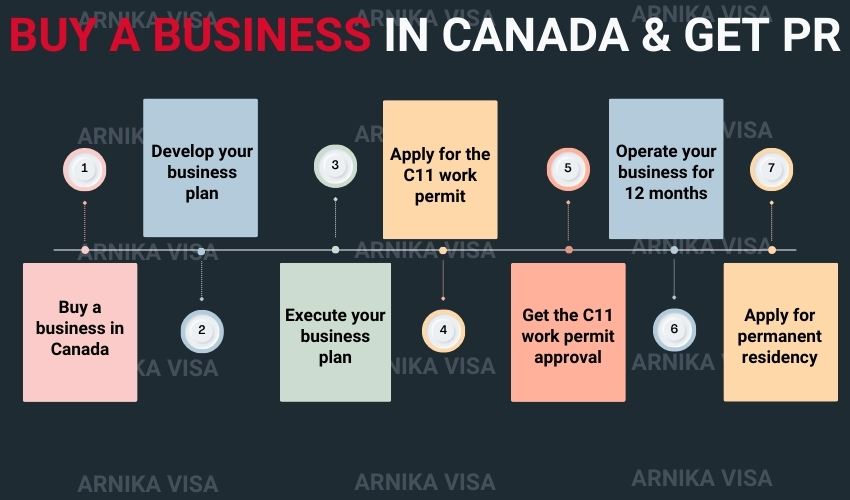
C11 Work Permit
The C11 Work Permit allows eligible foreign entrepreneurs to establish or acquire a Canadian business and actively manage its operations when they can demonstrate that the business will provide a significant economic, social, or cultural benefit to Canada, making it an attractive option for experienced business owners.
Unlike many employer-specific work permits, the C11 pathway does not require a Labour Market Impact Assessment (LMIA), making it an attractive option for experienced business owners.
C11 is a work-permit pathway—not a direct permanent-residence program.
Provincial Entrepreneur Programs
Some provinces and territories offer Canada Entrepreneur Visa streams, but eligibility, investment requirements, net worth requirements, business performance requirements, and application procedures vary by jurisdiction and can change over time.
Although eligibility requirements differ by province, applicants are generally expected to:
- Invest in or acquire a Canadian business.
- Actively manage the business.
- Meet minimum net worth and investment requirements.
- Create employment opportunities for Canadians or permanent residents.
Successful applicants may later become eligible for provincial nomination and, ultimately, permanent residence.
Important: Canada’s Start-Up Visa Program is currently closed to new applicants. Individuals considering an entrepreneur immigration strategy should verify the current status of federal and provincial programs before relying on a particular pathway.
Other Business Immigration Pathways
Depending on your business model and long-term objectives, other federal or provincial immigration programs may also be available.
Because every entrepreneur’s circumstances are different, selecting the most appropriate immigration strategy should involve both commercial planning and professional immigration advice.
Learn more in our complete guide to Canada Business Immigration and explore whether the C11 Work Permit or Provincial Entrepreneur Programs may be appropriate for your situation.
Common Mistakes When Buying a Business
Purchasing a business is a significant investment, and many costly mistakes can be avoided through careful preparation.
Some of the most common mistakes include:
Inadequate Due Diligence
Failing to review financial records, legal documents, tax obligations, or operational performance can expose buyers to unexpected liabilities after closing.
Always conduct comprehensive due diligence before making a commitment.
Paying More Than the Business Is Worth
The asking price does not always reflect fair market value.
Independent business valuations and professional financial advice can help buyers negotiate a reasonable purchase price.
Ignoring Existing Contracts
Commercial leases, supplier agreements, customer contracts, and employment obligations may all transfer with the business.
Understanding these commitments before purchasing helps avoid unexpected legal or financial responsibilities.
Underestimating Working Capital
Many buyers focus only on the purchase price.
Additional funds are often required for:
- Inventory.
- Equipment upgrades.
- Marketing.
- Employee wages.
- Operating expenses.
- Business improvements.
Maintaining adequate working capital is essential during the transition period.
Not Seeking Professional Advice
Business acquisitions involve legal, financial, tax, and commercial considerations.
Working with experienced accountants, lawyers, business brokers, and immigration professionals can help reduce risk and improve decision-making throughout the acquisition process.
Frequently Asked Questions
1. Can a foreigner start a business in Canada?
Yes. Starting a Business in Canada for Foreigners is possible. However, starting and owning a business does not automatically authorize you to work in Canada or obtain permanent residence. Depending on your circumstances, you may need an appropriate work permit or business immigration pathway.
The investment required depends entirely on the industry, location, size, and profitability of the business. Some small businesses may require relatively modest investments, while larger companies can involve substantially higher purchase prices.
3. Does buying a business guarantee permanent residence?
No.
Buying a business alone does not guarantee permanent residence. However, active business ownership and management may support certain Canadian business immigration programs if all program requirements are satisfied.
4. Should I buy shares or assets?
Both approaches have advantages.
An asset purchase generally allows buyers to select specific assets and liabilities, while a share purchase transfers ownership of the corporation itself. The appropriate structure depends on legal, tax, and commercial considerations.
Professional legal and tax advice is recommended before deciding.
5. Why is due diligence so important?
Due diligence helps buyers verify the financial, legal, operational, and commercial condition of the business before completing the purchase.
It significantly reduces the risk of unexpected liabilities after the transaction closes.
6. Can I finance the purchase of a business?
Yes.
Many acquisitions are financed through personal investment, commercial bank loans, seller financing, private investors, or a combination of these funding sources.
7. How long does it take to buy a business?
The timeline varies depending on the complexity of the transaction, financing arrangements, negotiations, regulatory approvals, and the due diligence process.
Simple transactions may be completed relatively quickly, while more complex acquisitions often require additional time.
8. Should I hire professional advisors before buying a business?
Yes.
Experienced lawyers, accountants, business brokers, and financial advisors can help evaluate opportunities, conduct due diligence, negotiate agreements, and reduce the risks associated with business acquisitions.
Need Professional Guidance?
Buying a business is one of the most significant financial decisions an entrepreneur can make. Careful planning, thorough due diligence, and a well-structured acquisition strategy can significantly improve the likelihood of long-term success.
At Arnika Visa, we assist entrepreneurs and investors who are purchasing Canadian businesses as part of their commercial expansion or business immigration plans.
Our services include:
- Business immigration consulting
- C11 Work Permit applications
- Business acquisition strategies
- Canada Immigration Business Plan
- Entrepreneur immigration planning
- Canadian business expansion consulting
Whether your goal is to invest in an existing business, expand internationally, or pursue business immigration opportunities, our experienced team can help you identify the most appropriate strategy.
Book a consultation today to discuss your business acquisition and immigration goals.
Related Business Immigration Guides


About the Author

Reviewed by Reza Eslami, RCIC (R710241)
Regulated Canadian Immigration Consultant specializing in Canadian business immigration and work permits.
Reza Eslami is a Regulated Canadian Immigration Consultant (RCIC) specializing in Canadian business immigration. He advises entrepreneurs, investors, and international companies on business acquisitions, C11 Work Permits, entrepreneur immigration, business expansion strategies, and long-term Canadian immigration planning.