

Starting a Business in Canada for Foreigners can be an excellent opportunity for entrepreneurs looking to build a successful company in one of the world’s most stable and business-friendly economies. Whether you are a Canadian citizen, permanent resident, or a foreign entrepreneur, understanding the legal requirements, registration process, business structures, and startup costs is essential before launching your business.
If you are a foreign entrepreneur interested in operating a business in Canada, you should also read our dedicated guide on Starting a Business in Canada for Foreigners, which explains available business immigration pathways, including the C11 Work Permit and applicable Provincial Entrepreneur Programs. The Start-Up Visa Program is currently closed for new applications.
Last updated: August 2026
Reviewed by Reza Eslami, RCIC (R710241)
Reading time: 8 minutes

Table of Contents
- Can Anyone Start a Business in Canada?
- Step 1: Choose the Right Business Structure
- Step 2: Register Your Business
- Step 3: Obtain Licences and Permits
- Step 4: Prepare a Business Plan
- Step 5: Estimate Your Startup Costs
- Step 6: Explore Business Financing Options
- Step 7: Understand Your Tax Obligations
- Step 8: Common Mistakes to Avoid
- Starting a Business as a Foreign Entrepreneur
- Frequently Asked Questions
- Need Professional Guidance?
Can Anyone Start a Business in Canada?
Yes. Canada welcomes entrepreneurs and offers a supportive environment for business ownership.
Canadian citizens and permanent residents can generally start a business without immigration restrictions. Foreign nationals may also establish a Canadian company, although operating the business or relocating to Canada may require the appropriate immigration status or work authorization.
If your goal is to move to Canada while operating your business, several business immigration pathways may be available depending on your circumstances. These include entrepreneur streams offered by provinces, the C11 Work Permit, the Start-Up Visa Program, and other business immigration options.
Planning to immigrate while starting your business? Read our complete guide on Starting a Business in Canada for Foreigners to learn about the available immigration pathways, including Starting a Business in Canada for Foreigners.

Step 1: Choose the Right Business Structure
Selecting the appropriate legal structure is one of the first and most important decisions when starting a business in Canada. Your choice affects taxation, liability, ownership, financing opportunities, and future growth.
The most common business structures include:
Sole Proprietorship
A sole proprietorship is the simplest and least expensive business structure.
It is owned and operated by one individual, who is personally responsible for all business debts and obligations. This structure is often suitable for freelancers, consultants, and small service-based businesses.
Advantages
- Easy to establish
- Low registration costs
- Simple tax reporting
- Complete management control
Considerations
- Unlimited personal liability
- More difficult to raise investment capital
- Limited opportunities for expansion
Partnership
A partnership allows two or more individuals or businesses to operate together.
Partners generally share profits, responsibilities, and liabilities according to a partnership agreement.
This structure is commonly used by professional firms, family businesses, and companies with multiple founders.
Corporation
A corporation is a separate legal entity distinct from its owners.
Incorporating a business offers greater liability protection and may provide tax planning advantages for growing companies.
Corporations are often preferred by businesses planning to hire employees, attract investors, or expand nationally.
Benefits include:
- Limited liability protection
- Improved business credibility
- Easier access to financing
- Better succession planning
However, corporations also require more administrative responsibilities, including annual filings and corporate record keeping.
Cooperative
A cooperative is owned and managed by its members, who collectively participate in decision-making and share the benefits generated by the business.
Although less common, cooperatives are frequently used in agriculture, housing, and community-based organizations.
Choose Where Your Business Will Operate
Your province, municipality, and business location can affect registration requirements, licences, taxes, commercial rent, labour costs, and market demand. Choose the location based on your target customers, operating costs, and regulatory requirements.
Step 2: Register Your Business
After selecting a business structure, the next step is registering your business.
The registration process depends on your chosen legal structure and where your business will operate.
Business Name Registration
If you intend to operate under a business name other than your personal legal name, you will generally need to register that name with the appropriate provincial or territorial authority.
Before registration, it is advisable to search existing business registries to confirm that your proposed name is available and does not conflict with existing businesses.
Choosing a distinctive and memorable business name can also strengthen your branding and marketing efforts.
Federal vs. Provincial Incorporation
Businesses that choose to incorporate must decide whether to incorporate federally or provincially.
Federal incorporation creates a federal corporation, while provincial or territorial incorporation creates a corporation under the laws of that jurisdiction. A corporation may need additional extra-provincial or extra-territorial registrations if it carries on business in other jurisdictions.
The appropriate option depends on your business objectives, growth plans, and geographic reach.
Obtain a Business Number (BN)
Depending on your business structure and CRA program accounts, you may need a Business Number (BN) from the Canada Revenue Agency (CRA). Corporations require a BN, while unincorporated businesses generally need one when registering for certain CRA program accounts.
Step 3: Obtain the Required Licences and Permits
Many businesses require licences or permits before beginning operations.
The requirements vary depending on:
- Industry
- Province or territory
- Municipality
- Business activities
For example:
- Restaurants may require food handling and health permits.
- Construction companies often require municipal licences.
- Transportation businesses may need provincial operating permits.
- Professional services may require licensing from regulatory bodies.
Before launching your business, confirm that all applicable federal, provincial, and municipal requirements have been satisfied.
Obtaining the necessary approvals at the beginning helps avoid penalties, delays, and operational disruptions later.
You can use BizPaL to identify licences and permits that may apply to your business. BizPaL can help entrepreneurs identify federal, provincial, territorial, and municipal licences and permits that may apply to their business.
Step 4: Prepare a Business Plan
A well-prepared business plan helps entrepreneurs define their objectives, understand their target market, estimate startup costs, and prepare realistic financial projections.
An effective Canada Immigration Business Plan typically includes:
- Executive summary
- Company description
- Market analysis
- Products or services
- Marketing strategy
- Operations plan
- Financial projections
- Growth strategy
Even if you are not seeking financing, preparing a business plan provides a roadmap for making informed business decisions and measuring future performance.
For entrepreneurs applying through Canadian business immigration programs, a professional business plan is often an essential component of the application.
Step 5: Estimate Your Startup Costs
Understanding your startup costs is an important part of building a successful business. The amount of capital required depends on your industry, business model, location, and whether you are operating online, from home, or through a commercial premises.
Common startup expenses may include:
- Business registration and incorporation fees
- Professional legal and accounting services
- Office or retail lease deposits
- Equipment and technology
- Website development and branding
- Marketing and advertising
- Insurance
- Inventory and supplies
- Employee recruitment and training
- Working capital for the first few months
Preparing a realistic budget helps reduce financial risk and ensures your business has sufficient resources during its early stages.
How Much Does It Cost to Start a Business in Canada?
There is no single minimum amount required to start a business in Canada. Costs vary by business structure, industry, location, staffing, equipment, inventory, licences, and working capital. A home-based service business may require relatively little capital, while a restaurant, retail store, or manufacturing business can require substantially more.
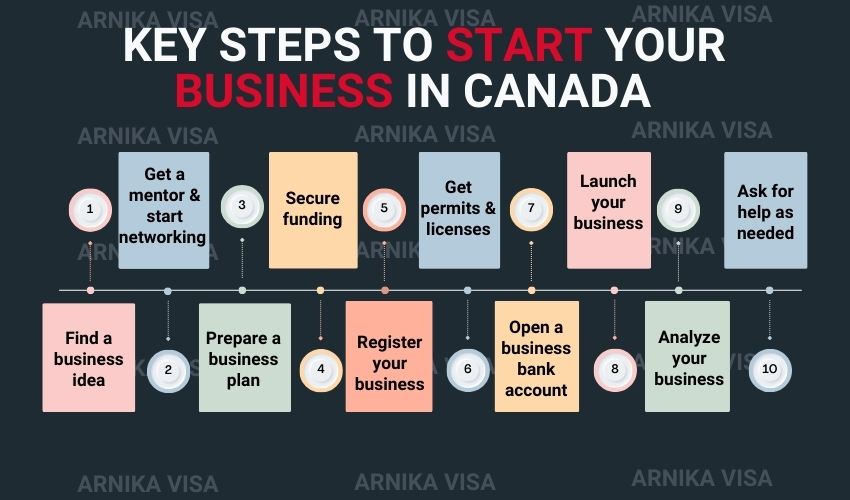
Step 6: Explore Business Financing Options
Many entrepreneurs use a combination of personal savings and external financing to launch their businesses.
Canada offers several funding options depending on the size and nature of the business.
Personal Investment
Many small businesses are initially financed through personal savings or contributions from business partners. Self-funding allows entrepreneurs to retain full ownership and control during the startup phase.
Bank Loans
Canadian banks offer business loans and lines of credit for qualified entrepreneurs. Approval is generally based on factors such as your credit history, financial capacity, business experience, and the strength of your business plan.
Government Programs
Depending on the business and eligibility criteria, entrepreneurs may have access to financing programs, grants, and support services offered by governments and financial institutions. Eligibility requirements vary by province and program, so entrepreneurs should research available opportunities before applying.
Private Investors
Growing businesses may also attract funding from angel investors, venture capital firms, or private investment groups.
These investors often look for businesses with strong growth potential, experienced management teams, and scalable business models.
Step 7: Understand Your Tax Obligations
Every business operating in Canada has tax responsibilities. Understanding these obligations from the beginning can help you avoid penalties and ensure compliance with federal and provincial regulations.
Depending on your business activities, you may need to register for:
GST/HST
Businesses whose taxable revenues exceed the applicable registration threshold are generally required to register for the Goods and Services Tax (GST) or Harmonized Sales Tax (HST).
Even businesses below the threshold may choose to register voluntarily in certain situations. The applicable tax obligations depend on your business structure, revenue, activities, and province or territory.
Payroll Accounts
If you hire employees, you must establish a payroll account with the Canada Revenue Agency (CRA).
Employers are responsible for withholding and remitting income tax, Canada Pension Plan (CPP) contributions, and Employment Insurance (EI) premiums.
Corporate Income Tax
Corporations must file annual corporate income tax returns and comply with applicable federal and provincial tax requirements.
Maintaining accurate accounting records throughout the year makes tax reporting significantly easier.
Many entrepreneurs choose to work with accountants or bookkeepers to ensure ongoing compliance.
Step 8: Common Mistakes to Avoid
Many new businesses encounter avoidable challenges during their first few years. Careful planning can help reduce these risks.
Some of the most common mistakes include:
Choosing the Wrong Business Structure
Selecting an inappropriate legal structure may create unnecessary tax obligations or expose owners to additional personal liability.
Professional legal or accounting advice can help determine the most suitable structure for your business.
Starting Without a Business Plan
Many entrepreneurs underestimate the value of a business plan.
A comprehensive plan helps establish realistic financial goals, identify market opportunities, and guide business growth.
Ignoring Licensing Requirements
Operating without the necessary licences or permits can result in fines, delays, or even business closure.
Always confirm regulatory requirements before beginning operations.
Underestimating Startup Costs
Many businesses require more working capital than initially expected.
Building a financial buffer into your startup budget can help manage unexpected expenses during the early stages of operation.
Neglecting Tax Planning
Failing to understand tax obligations may lead to penalties or cash flow problems.
Maintaining accurate financial records from the beginning makes ongoing compliance much easier.
Starting a Business as a Foreign Entrepreneur
Foreign nationals can establish or invest in Canadian businesses, but owning a business does not automatically give them the right to work in Canada. If you plan to actively operate the business from Canada, you must determine whether you need a work permit or other immigration authorization.
Several Canadian business immigration pathways may allow eligible entrepreneurs to build and operate businesses in Canada, including:
- C11 Work Permit
- Provincial Entrepreneur Programs
- Start-Up Visa Program
The most appropriate pathway depends on your business objectives, investment level, and long-term immigration plans.
Learn more in our detailed guide: Starting a Business in Canada for Foreigners.
Frequently Asked Questions
1. Can I start a business in Canada without being a Canadian citizen?
Yes. Foreign nationals can establish a business in Canada, although operating the business or moving to Canada may require an appropriate work permit or immigration status.
2. How much money do I need to start a business in Canada?
Startup costs vary depending on the type of business, industry, and location. Home-based businesses generally require less capital than retail stores or manufacturing operations.
3. Do I need to incorporate my business?
Not necessarily. Many entrepreneurs begin as sole proprietors before incorporating as their businesses grow.
4. Do I need a business plan?
A business plan is highly recommended. It helps guide business decisions, obtain financing, and may be required for certain immigration programs or investment opportunities.
5. Can foreigners register a corporation in Canada?
Foreign nationals may be able to establish or own a Canadian corporation, but corporate residency, director registration, and operating requirements can vary by federal or provincial jurisdiction. Professional advice may be appropriate before incorporation.
6. What taxes does a new business pay?
Depending on your business activities, you may need to register for GST/HST, payroll deductions, and corporate income tax. Tax obligations vary based on your business structure and revenue.
7. How long does it take to start a business in Canada?
The timeline varies depending on the business structure, province, business name, licences, permits, and other requirements. A simple business may be registered relatively quickly, while businesses requiring licences, inspections, financing, or specialized approvals can take longer.
Official sources
Related Articles
Continue learning about business and immigration opportunities in Canada:
Need Professional Guidance?
Starting a business involves more than registering a company—it requires careful planning, legal compliance, and a clear strategy for long-term success.
At Arnika Visa, we help entrepreneurs establish businesses in Canada while providing guidance on business immigration pathways for those planning to relocate or expand internationally.
Our services include:
- Business immigration consulting
- C11 Work Permit applications
- Entrepreneur immigration strategies
- Business acquisition consulting
- Immigration business plans
- Canadian business expansion guidance
Whether you are launching a new venture or expanding an existing company, our experienced team can help you identify the most appropriate strategy.
Book a consultation today to discuss your business goals in Canada.

About the Author

Reviewed by Reza Eslami, RCIC (R710241)
Regulated Canadian Immigration Consultant specializing in Canadian business immigration and work permits.
Reza Eslami is a Regulated Canadian Immigration Consultant (RCIC) specializing in Canadian business immigration. He advises entrepreneurs, investors, and international companies on C11 Work Permits, entrepreneur immigration, business acquisitions, business expansion strategies, and Canadian immigration planning.