
Canada offers several provincial and territorial immigration pathways for experienced entrepreneurs who intend to establish, purchase, and actively manage a business. These are not one national entrepreneur visa. Each participating jurisdiction sets its own eligibility rules, selection process, business expectations, and nomination requirements.
A provincial entrepreneur pathway may lead to permanent residence after the applicant is selected, obtains any required authorization to come to Canada, establishes or purchases an eligible business, and meets the province’s performance conditions. Meeting minimum criteria does not guarantee an invitation, nomination, or permanent residence.
This guide explains how entrepreneur immigration Canada works, which provincial options to investigate, what applicants should prepare, and how provincial entrepreneur programs differ from temporary work permit pathways such as C11 and Intra-Company Transfer (ICT). Program availability can change; confirm current intake and program guides before committing funds.
Entrepreneur immigration Canada generally refers to provincial or territorial business immigration pathways for people with business ownership or senior management experience who plan to operate a qualifying business in a particular jurisdiction.
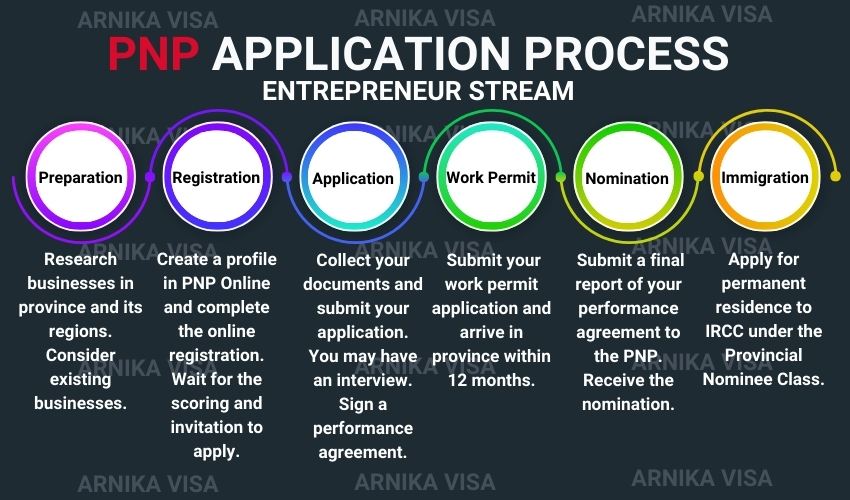
Many programs use a staged process: an Expression of Interest (EOI), invitation, full application, and (if approved) a business performance agreement. Depending on the stream, the entrepreneur may obtain a work permit, establish or purchase the business, and operate it for a required period. The province may consider nomination after the applicant demonstrates compliance.
A provincial nomination is not permanent residence. IRCC makes the final decision on the permanent residence application and assesses federal admissibility.
For a broader comparison of Canadian business pathways, read our Canada Business Immigration Guide.
These programs are generally intended for applicants who can demonstrate relevant business or senior management experience, sufficient and lawfully obtained funds, and a credible plan to establish or acquire and actively manage a business in the province.
A person seeking only to invest money without participating in business management will generally not fit the purpose of these programs. Definitions of qualifying experience, ownership, management duties, and eligible investment vary by stream.
This is a navigation overview, not a guarantee that a stream is accepting applications. Intake status, selection priorities, and eligibility can change. Confirm the official program page before preparing an EOI or transferring funds.
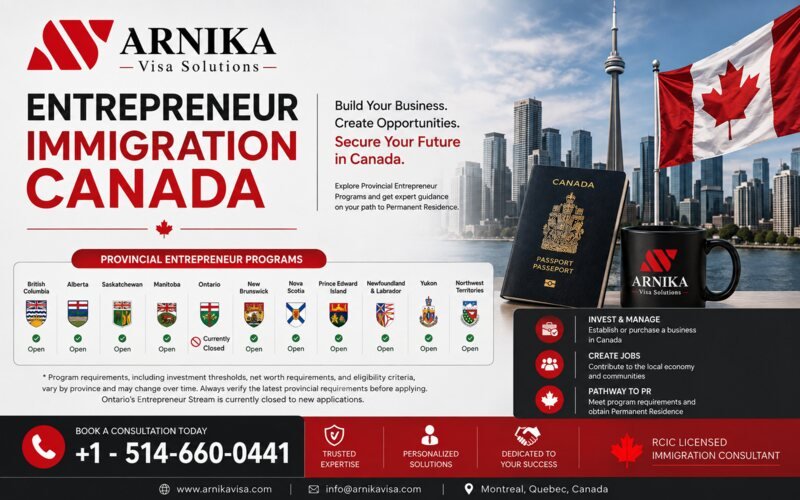
Jurisdiction | Program to investigate | Important qualification |
British Columbia | Entrepreneur Immigration – Base and Regional streams | Invitations are selective. |
Alberta | Rural Entrepreneur, Graduate Entrepreneur, Farm, and Foreign Graduate Entrepreneur | Stream-specific eligibility and AAIP updates apply. |
Manitoba | Business Investor Stream – Entrepreneur Pathway | Verify current intake and availability directly with Manitoba. |
New Brunswick | Business Immigration Stream | Replaced the former Entrepreneurial Stream. |
Nova Scotia | Entrepreneur Stream and International Graduate Entrepreneur sub-criteria | Invitation-based; check current criteria and fees. |
Prince Edward Island | Business Impact Category – Work Permit Stream | EOI is not an application or guarantee of invitation. |
Newfoundland and Labrador | International Entrepreneur category | Official page describes an open EOI system; selection conditions apply. |
Northwest Territories | NTNP Business Stream | Review current guidelines and confirm intake. |
Yukon | Business Nominee Program | Confirm current intake and requirements directly with Yukon. |
Saskatchewan | Entrepreneur and Farm pathways | Permanently closed to new applicants effective March 27, 2025. |
Ontario | Former OINP Entrepreneur Stream | Closed under Ontario’s 2026 program restructuring. |
Ontario’s former OINP Entrepreneur Stream should not be presented as open to new applicants. Ontario’s 2026 restructuring states that the former streams have closed. Entrepreneurs considering Ontario should assess other lawful options without assuming that a temporary work permit leads automatically to permanent residence.
Saskatchewan permanently closed its Entrepreneur and Farm immigration pathways effective March 27, 2025. The province states it will not accept new applications, consider new EOIs, or issue further invitations under those pathways. Existing applications continue to be processed.
The federal Start-Up Visa Program is paused as of June 30, 2026. IRCC states that the limited transition applies to applicants with a valid 2025 commitment certificate who applied by June 30, 2026. IRCC continues processing applications received before the deadline. New applicants should not treat it as an available route.
The federal Start-Up Visa is distinct from provincial entrepreneur programs. They have different eligibility rules, business models, and application processes.
There is no universal checklist or single investment threshold for entrepreneur immigration Canada. Each province defines its own criteria. Common assessment areas include:
Applicants may need to show a minimum period of ownership or senior management experience. Evidence can include corporate records, ownership documents, financial statements, tax filings, organizational charts, employment records, and an explanation of actual management duties.
Some streams set a minimum net worth and require verification by an approved professional. Document how assets were accumulated, ownership, valuation, liabilities, lawful source, and transferability.
The required investment depends on the province, stream, location, and business. Budget for eligible investment, working capital, premises, equipment, inventory, payroll, insurance, taxes, and unexpected costs.
Entrepreneur streams generally expect the applicant to live in the province and actively manage the business. Passive ownership or remote oversight may not meet program requirements.
Some programs require jobs for Canadian citizens or permanent residents; others assess regional development, innovation, or other economic contributions.
Language tests, education, age ranges, exploratory visits, interviews, and other selection factors may apply. Requirements are not uniform across Canada.
There is no single minimum investment or net worth amount for entrepreneur immigration Canada. Identify the exact provincial stream first, then calculate the total funds required under its current rules.
Do not purchase a business, sign a non-refundable agreement, or transfer a large deposit solely because a pathway appears to have a low minimum investment. Confirm eligibility, intake, due diligence, and immigration implications first.
Some provincial entrepreneur programs permit an applicant to purchase an existing business, while others impose conditions on business history, ownership, valuation, location, continuity, and the applicant’s role after purchase.
Conduct commercial and legal due diligence: review financial statements, tax filings, contracts, leases, licences, employee obligations, inventory, equipment, debts, litigation, and the reason for sale. Separately confirm that the transaction meets the selected stream’s rules. A commercially sound purchase is not automatically an eligible immigration investment.
A provincial entrepreneur pathway is built around a qualifying business in a particular province, active management, and compliance with a performance agreement. If the applicant satisfies the program conditions, the province may nominate them for permanent residence. Federal admissibility and IRCC approval still apply.
C11 is a temporary, LMIA-exempt work permit category that may be available to an entrepreneur or self-employed person whose proposed work in Canada is expected to provide significant benefit. It is not a provincial nomination and does not itself grant permanent residence. The applicant must meet applicable work permit requirements and demonstrate a genuine temporary plan.
Read our detailed C11 Work Permit Canada guide.
ICT may be relevant where an established foreign enterprise transfers a qualifying employee to a related Canadian parent, subsidiary, branch, or affiliate. It is not a general route for an individual to start an unrelated Canadian business.
Read our Intra-Company Transfer (ICT) Canada guide.
For a broader comparison, return to the Canada Business Immigration Guide.
Not every stream follows this sequence. Some require exploratory visits, interviews, concept approval, or different work permit arrangements. Follow the current guide and written instructions for the specific stream.
Financial projections should be internally consistent and supported by evidence. The business plan must reflect what the applicant genuinely intends and can implement.
Yes. Some provincial programs provide a potential route after the applicant is selected, establishes or purchases and operates the business, meets the performance agreement, and receives a provincial nomination. IRCC makes the final decision.
Possibly. Some streams accept qualifying senior management experience; others require ownership or specific ownership thresholds. Check the exact stream.
Some programs permit acquisitions, subject to conditions. The business, transaction, investment, and applicant’s active management role must meet the selected program’s rules.
No. Investment and net worth requirements vary by province and stream. There is no single Canada-wide entrepreneur investment threshold.
Eligible family members may be able to accompany or join the principal applicant. Their status and any work or study authorization depend on the rules at the time. A spouse does not automatically qualify for an open work permit.
No. IRCC paused the federal Start-Up Visa Program on June 30, 2026. The limited transition applies to eligible applicants with a valid 2025 commitment certificate who applied by that date.
No. IRCC must still assess the permanent residence application, including admissibility and federal requirements.
There is no single timeline. It may include provincial selection, application assessment, work permit processing, business operation, nomination, and federal processing.
Choosing an entrepreneur immigration pathway requires more than comparing investment amounts. The proposed business must make commercial sense, fit the selected program’s requirements, and be manageable within the applicant’s financial and operational capacity.
At Arnika Visa, Reza Eslami, RCIC (R710241), assists entrepreneurs and business owners with assessing potential immigration pathways, reviewing eligibility, developing business immigration strategies, and preparing or reviewing immigration applications and supporting documentation.
The appropriate strategy depends on your business background, source of funds, proposed investment, preferred province, and immigration objectives. No program or application outcome can be guaranteed.
Contact Arnika Visa to book a consultation and discuss your entrepreneur immigration options.
Reviewed by Reza Eslami, RCIC (R710241), Regulated Canadian Immigration Consultant and founder of Arnika Visa. His practice focuses on Canadian business immigration, work permits, visitor visas, study permits, family sponsorship, and permanent residence applications.