

The C11 Work Permit Canada (C11 Visa Canada) is an LMIA-exempt work permit for entrepreneurs, business owners, investors, and self-employed individuals who can demonstrate that their business will provide a significant benefit to Canada. It may also lead to permanent residence through other immigration pathways.
Unlike employer-sponsored work permits, the C11 category is designed for entrepreneurs, investors, and self-employed individuals whose proposed business activities are expected to provide a significant economic, social, or cultural benefit to Canada. Whether you plan to launch a new company or acquire an existing Canadian business, the C11 Work Permit may allow you to establish your business while living and working in Canada.
Although the C11 Work Permit does not automatically lead to permanent residence, many applicants later become eligible for Canadian immigration programs after successfully operating their businesses and gaining Canadian work experience. If you’re comparing all available pathways for entrepreneurs and investors, see our Canada Business Immigration Guide, which explains both temporary and permanent business immigration options.
Key Takeaways:
✅ No LMIA required
✅ No minimum investment
✅ Can buy or start a business
✅ Requires significant benefit
✅ May lead to PR
In this guide, you’ll learn everything you need to know about the C11 Work Permit, including eligibility requirements, significant benefit criteria, business plans, investment expectations, required documents, application steps, processing times, and possible pathways to permanent residence.
Last updated: August 2026
Reviewed by Reza Eslami, RCIC (R710241)
Reading time: 8 minutes
Table of Contents
- What Is the C11 Work Permit Canada?
- Who Can Apply?
- C11 Work Permit vs ICT Work Permit
- Benefits of the C11 Visa Canada
- Eligibility Requirements
- Significant Benefit to Canada
- How IRCC Assesses a C11 Application
- Starting vs Buying a Business
- Business Plan Requirements
- Minimum Investment Requirement
- Documents Required
- How to Apply
- C11 work permit Processing Time
- Can It Lead to Permanent Residence?
- Can Family Members Come?
- Who Should NOT Apply?
- Common Reasons Applications Are Refused
- Can I Apply from Inside Canada?
- Can I Bring Employees?
- Frequently Asked Questions
- Need Professional Assistance?
What Is the C11 Work Permit?
The C11 Work Permit is an LMIA-exempt work permit that allows entrepreneurs, business owners, and certain self-employed individuals to establish or purchase a business in Canada if they can demonstrate that their business will provide a significant benefit to the Canadian economy, society, or culture.
Unlike most employer-specific work permits, applicants under the C11 category are effectively applying to work for a business they own or control. Instead of proving that no Canadian worker is available for the position through an LMIA, applicants must demonstrate that their business activities will generate meaningful benefits for Canada.
Depending on the nature of the business, these benefits may include:
- Creating jobs for Canadians and permanent residents.
- Introducing innovative products or services.
- Supporting regional economic development.
- Expanding export opportunities.
- Providing unique cultural or social contributions.
The initial work permit is generally issued for a temporary period and may be extended if the business continues to operate successfully and the applicant remains eligible.
For many entrepreneurs, the C11 Work Permit serves as an effective first step toward establishing a long-term presence in Canada.

Who Can Apply for a C11 Work Permit?
The C11 Work Permit is designed for foreign nationals who intend to actively manage and operate their own Canadian business rather than work as employees for another employer.
Applicants generally fall into one of the following categories.
Entrepreneurs
Entrepreneurs planning to establish a new business in Canada may qualify if they can demonstrate that their business will create a significant benefit for the Canadian economy, society, or culture.
Applicants should have relevant business experience, sufficient financial resources, and a realistic business plan showing how the company will operate successfully in Canada.
Business Owners
Owners of established businesses outside Canada who wish to expand their operations by creating or acquiring a Canadian business may also qualify under the C11 category.
Business owners must demonstrate genuine ownership, active involvement in the business, and the ability to successfully manage Canadian operations.
Depending on the circumstances, some business owners who already operate an established company outside Canada may qualify for an Intra Company Transfer (ICT) Work Permit, which allows multinational businesses to expand into Canada by transferring executives, managers, or specialized knowledge employees.
Foreign Investors
Foreign investors who intend to purchase an existing Canadian business may qualify if they will actively participate in managing and operating the business after acquisition.
Passive investment alone does not qualify for a C11 Work Permit. Immigration officers expect applicants to play a direct role in the day-to-day management and growth of the business.
Self-Employed Professionals
Certain self-employed individuals may also qualify if they can demonstrate that their proposed activities will provide a significant benefit to Canada.
Examples may include professionals with specialized expertise, innovative business concepts, or services that address specific market needs.
However, simply being self-employed is not sufficient. Applicants must still satisfy all C11 eligibility requirements and convince immigration officers that their business activities will benefit Canada.

C11 Work Permit vs. ICT Work Permit
Entrepreneurs often compare the C11 Work Permit with the Intra Company Transfer (ICT) Work Permit because both are LMIA-exempt pathways for business immigration. However, they are designed for different situations.
Feature | C11 Work Permit | ICT Work Permit |
|---|---|---|
| Best suited for | Entrepreneurs starting or purchasing a Canadian business | Existing international companies expanding into Canada |
| Foreign business required | No | Yes |
| Canadian company required before applying | Usually yes | Yes |
| LMIA required | No | No |
| Main eligibility requirement | Significant Benefit to Canada | Qualifying relationship between foreign and Canadian businesses |
| Suitable for new entrepreneurs | Yes | No |
| Potential pathway to permanent residence | Yes | Yes |
If you already operate an established business outside Canada and plan to expand into the Canadian market, the ICT Work Permit may be the more appropriate option. If you intend to launch a new venture or independently acquire an existing Canadian business, the C11 Work Permit is often the better fit.
Choosing the right pathway depends on your business structure, ownership, long-term immigration goals, and expansion strategy.
Benefits of the C11 Work Permit
The C11 Work Permit offers several advantages for entrepreneurs and business owners looking to establish themselves in Canada.
Some of the key benefits include:
- LMIA exemption, eliminating the need to obtain a Labour Market Impact Assessment before applying.
- Operate your own business in Canada as an owner or entrepreneur.
- Start a new business or purchase an existing Canadian business, depending on your business objectives.
- Bring your spouse and dependent children, who may be eligible for open work permits or study opportunities, depending on their circumstances.
- Renew your work permit, provided the business remains active and you continue to meet program requirements.
- Potential pathway to permanent residence after gaining Canadian business and work experience through other immigration programs.
- Business flexibility, allowing applicants to choose industries and locations that best align with their experience and investment strategy.
- Opportunity to contribute to Canada’s economy by creating jobs, introducing innovation, and supporting local communities.
For many entrepreneurs, the C11 Work Permit provides a practical way to establish a Canadian business while exploring long-term immigration opportunities.

C11 Work Permit Eligibility Requirements
To qualify for a C11 Work Permit Canada, applicants must demonstrate that they meet the requirements established by Immigration, Refugees and Citizenship Canada (IRCC). While every application is assessed individually, immigration officers generally evaluate whether both the applicant and the proposed business satisfy the objectives of the C11 category.
Unlike many employer-sponsored work permits, approval is not based solely on a job offer. Instead, officers consider the applicant’s business experience, financial capacity, ownership interest, business plan, and the overall benefit the proposed business will bring to Canada.
The following are the primary eligibility requirements.
Business Ownership and Active Management
The C11 Work Permit is intended for entrepreneurs who will actively own, manage, and operate their Canadian business.
Applicants should generally demonstrate that they have sufficient ownership and decision-making authority to control the business and direct its day-to-day operations.
Passive investors who simply contribute capital without actively participating in management are generally not eligible under the C11 category.
Immigration officers expect applicants to play a meaningful role in the success and operation of the business after arriving in Canada.
Evidence may include:
- Business ownership documents.
- Shareholder agreements.
- Corporate registration records.
- Partnership agreements.
- Organizational structure.
The stronger the evidence of genuine ownership and active management, the stronger the application.
Relevant Business or Management Experience
Owning a business alone does not guarantee approval.
Applicants should demonstrate that they possess the education, professional background, or business experience necessary to successfully operate the proposed Canadian business.
Depending on the industry, relevant experience may include:
- Previous business ownership.
- Executive or senior management positions.
- Industry-specific expertise.
- Entrepreneurial experience.
- Professional qualifications.
- Investment management experience.
Immigration officers assess whether the applicant has the skills and knowledge required to implement the proposed business plan successfully.
Sufficient Financial Capacity
Applicants must demonstrate that they have adequate financial resources to establish, purchase, or operate the proposed business in Canada.
Although the C11 Work Permit does not require a fixed minimum investment amount, applicants should show they have enough funds to support both:
- The Canadian business.
- Their personal living expenses during the initial stages of operation.
Depending on the business, supporting financial evidence may include:
- Bank statements.
- Investment portfolios.
- Corporate financial statements.
- Business purchase agreements.
- Loan approvals.
- Proof of available operating capital.
Immigration officers evaluate whether the proposed business has realistic financial support rather than focusing on a specific investment threshold.
A Genuine and Viable Business
The proposed Canadian business must be genuine and commercially viable.
Applicants should demonstrate that the business has realistic prospects for long-term success rather than existing solely to obtain a work permit.
Factors officers may consider include:
- Market demand.
- Industry conditions.
- Business location.
- Competitive analysis.
- Revenue projections.
- Staffing plans.
- Operational strategy.
- Financial forecasts.
A well-prepared business plan supported by credible evidence significantly strengthens an application.
Temporary Intent
Like most temporary residents, C11 applicants must satisfy immigration officers that they intend to comply with the conditions of their work permit.
Although many entrepreneurs ultimately pursue permanent residence, the C11 Work Permit remains a temporary immigration program.
Applicants should demonstrate that they understand the temporary nature of the permit and will comply with Canadian immigration laws throughout their authorized stay.
Canadian immigration law recognizes that applicants may have dual intent, meaning they may seek temporary status while also planning to apply for permanent residence in the future if they become eligible.
Many entrepreneurs also compare the C11 pathway with provincial entrepreneur programs. Our Entrepreneur Immigration Canada Guide explains how Provincial Nominee Programs (PNPs) differ from temporary work permit options.
Ability to Successfully Establish the Business
Beyond financial resources, immigration officers assess whether applicants have taken meaningful steps toward establishing their Canadian business.
Evidence of preparation may include:
- Incorporating a Canadian company.
- Registering a business name.
- Leasing commercial premises.
- Purchasing an existing business.
- Obtaining industry licences or permits.
- Opening a Canadian business bank account.
- Building relationships with suppliers or customers.
- Developing a detailed business plan.
Demonstrating genuine preparation helps show that the business is more than a concept and is ready to begin operating.
Demonstrating a Significant Benefit to Canada
Perhaps the most important requirement of the C11 Work Permit is demonstrating that the proposed business will provide a significant benefit to Canada.
This benefit may be:
- Economic.
- Social.
- Cultural.
Immigration officers consider whether the applicant’s business is likely to create meaningful value for Canadian communities, industries, or the economy as a whole.
Examples may include:
- Creating employment opportunities.
- Introducing innovative products or services.
- Expanding Canadian exports.
- Supporting regional development.
- Addressing shortages in specialized industries.
- Enhancing cultural diversity or community services.
There is no single formula for determining significant benefit. Instead, officers assess the overall strength of the business proposal and the evidence provided with the application.
According to IRCC guidelines, the significant benefit is the foundation of every successful C11 application; so we examine this requirement in greater detail below.

How Immigration Officers Assess a C11 Application
Every C11 application is reviewed individually. Rather than relying on a checklist alone, immigration officers evaluate the overall credibility of the applicant, the business, and the proposed economic activity.
When reviewing an application, officers typically consider questions such as:
- Does the applicant have the experience to operate the proposed business?
- Is the business commercially realistic?
- Has the applicant committed sufficient financial resources?
- Is there credible evidence that the business will begin operating?
- Will the applicant actively manage the business?
- Is the business likely to provide a significant benefit to Canada?
- Are the supporting documents consistent with the information provided throughout the application?
Strong C11 applications tell a clear and consistent story. The business plan, financial evidence, ownership documents, and supporting materials should work together to demonstrate that the proposed business is genuine, sustainable, and capable of making a positive contribution to Canada.
What Does "Significant Benefit to Canada" Mean?
One of the most important requirements for obtaining a C11 Work Permit Canada is demonstrating that your proposed business will provide a significant benefit to Canada.
Unlike many other work permits, the C11 category does not require a Labour Market Impact Assessment (LMIA). Instead, immigration officers assess whether allowing you to operate your business in Canada is likely to generate meaningful economic, social, or cultural benefits.
There is no single checklist that guarantees approval. Every application is assessed individually based on the overall strength of the business proposal, supporting evidence, and the applicant’s experience.
A successful application should clearly demonstrate how the business will positively contribute to Canada.
Economic Benefits
Economic benefit is the most common way entrepreneurs satisfy the significant benefit requirement.
Immigration officers may consider whether your business is expected to:
- Create employment opportunities for Canadians and permanent residents.
- Invest capital into the Canadian economy.
- Introduce innovative products or services.
- Expand international trade.
- Support local suppliers and service providers.
- Increase tax revenue.
- Strengthen regional economic development.
- Address shortages in specific industries.
The size of the business is less important than its overall contribution. A well-managed small business may provide significant economic benefits even if it employs only a few people initially.
Social Benefits
Some businesses generate benefits that extend beyond economic growth.
Examples include businesses that:
- Improve access to essential community services.
- Support underrepresented communities.
- Enhance education or professional training.
- Promote environmental sustainability.
- Improve healthcare or public well-being.
- Provide valuable services in rural or underserved regions.
Applicants should explain how their business contributes positively to Canadian society rather than focusing only on financial success.
Cultural Benefits
Certain businesses contribute to Canada’s cultural diversity and creative industries.
Examples may include businesses involved in:
- Arts and entertainment.
- Film and media production.
- Cultural education.
- Heritage preservation.
- Music and performing arts.
- International cultural exchange.
Although cultural benefit applies to fewer businesses, it may strengthen applications in appropriate industries.
How to Demonstrate Significant Benefit
Simply stating that your business will benefit Canada is not enough.
Immigration officers expect supporting evidence.
Depending on your business, evidence may include:
- A detailed business plan.
- Market research.
- Industry reports.
- Financial projections.
- Hiring plans.
- Partnership agreements.
- Letters of support.
- Client contracts.
- Purchase agreements.
- Marketing strategy.
- Evidence of previous business success.
The strongest applications combine objective evidence with a realistic explanation of how the business will operate successfully in Canada.
Examples of Significant Benefit
Every business is different, but examples may include:
Technology Company
Developing innovative software while hiring Canadian professionals and expanding exports.
Manufacturing Business
Opening a production facility that creates local employment and strengthens domestic supply chains.
Professional Services Firm
Providing specialized consulting services unavailable in certain Canadian regions while creating skilled employment opportunities.
Retail Business
Purchasing an existing Canadian business, preserving local jobs, and expanding operations.
The focus should always be on demonstrating genuine and measurable benefits rather than making broad promises.
Starting a Business vs. Buying a Business Under the C11 Work Permit
Entrepreneurs applying for a C11 Work Permit Canada generally choose one of two approaches:
- Start a new business.
- Purchase an existing Canadian business.
Each option offers different advantages depending on your experience, investment capacity, and business goals.
Starting a New Business
Launching a new business provides complete flexibility over your operations, branding, and long-term strategy.
Advantages include:
- Full control over business decisions.
- Ability to introduce innovative products or services.
- Opportunity to build operations from the ground up.
- Greater flexibility in choosing the business model.
Challenges may include:
- Building a customer base.
- Recruiting employees.
- Developing supplier relationships.
- Achieving profitability.
A strong market analysis and realistic business plan become especially important when establishing a new business.
Buying an Existing Business
Many entrepreneurs choose to purchase an established Canadian business instead of creating one from scratch.
Advantages include:
- Existing customers.
- Established revenue.
- Operational systems already in place.
- Experienced employees.
- Existing supplier relationships.
- Proven business model.
However, buyers should conduct proper due diligence before completing any purchase.
Important considerations include:
- Financial performance.
- Existing liabilities.
- Lease agreements.
- Customer contracts.
- Employee obligations.
- Future growth opportunities.
Purchasing the right business may reduce startup risk while providing immediate commercial activity.
Before acquiring an existing company, read our complete guide on Buying a Business in Canada to understand legal, financial, and immigration considerations.

Business Plan Requirements for a C11 Work Permit
A well-prepared business plan is often one of the most important documents in a successful C11 application.
The business plan demonstrates not only how your company will operate but also why your business deserves approval under Canada’s significant benefit requirement.
Although there is no official IRCC template, a comprehensive business plan should typically include:
- Executive summary.
- Company background.
- Description of products or services.
- Canadian market analysis.
- Industry and competitor research.
- Marketing strategy.
- Operational plan.
- Organizational structure.
- Hiring strategy.
- Financial projections.
- Cash flow forecast.
- Investment budget.
- Risk analysis.
- Growth strategy.
Your business plan should clearly explain why your business is commercially viable and how it will contribute to Canada’s economy or society.
Learn what immigration officers expect by reading our detailed guide on creating a Business Plan for Canada Business Immigration.
Is There a Minimum Investment Requirement?
No. There is no official minimum investment requirement for the C11 Visa Canada. Instead, applicants must demonstrate that they have sufficient financial resources to successfully establish and operate their proposed Canadian business.
The amount required depends on several factors, including:
- Industry.
- Business model.
- Location.
- Startup costs.
- Staffing requirements.
- Equipment purchases.
- Lease obligations.
- Operating expenses.
For example, a consulting business may require significantly less capital than a manufacturing company or restaurant.
Rather than focusing on a specific dollar amount, applicants should demonstrate that they have realistic funding available to support both the business and their personal living expenses during the startup phase.
A well-supported financial plan often carries more weight than the total amount invested.
Documents Required for a C11 Work Permit
The documents required for a C11 Work Permit Canada vary depending on your business, industry, and personal circumstances. However, applicants should be prepared to provide evidence supporting both their eligibility and the proposed Canadian business.
Submitting a complete and well-organized application helps immigration officers assess your case more efficiently and reduces the likelihood of delays or requests for additional information.
Business Documents
Documents relating to the Canadian business may include:
- Articles of Incorporation or Business Registration.
- Shareholder agreements.
- Business purchase agreement (if purchasing an existing business).
- Business licences or permits (where applicable).
- Commercial lease agreement (if available).
- Corporate organizational chart.
- Business bank account information.
- Supplier or customer agreements.
- Company website or marketing materials.
These documents help establish that the business is genuine and ready to operate in Canada.
Personal Documents
Applicants should also provide documents demonstrating their identity, qualifications, and business experience.
Examples include:
- Valid passport.
- Resume or Curriculum Vitae (CV).
- Educational credentials.
- Professional licences or certifications (if applicable).
- Employment reference letters.
- Evidence of previous business ownership or management experience.
Financial Documents
Immigration officers will review your financial capacity to determine whether you can successfully establish and operate your Canadian business.
Supporting financial evidence may include:
- Personal bank statements.
- Corporate financial statements.
- Investment account statements.
- Proof of available business funds.
- Loan approvals (if applicable).
- Asset ownership documents.
Applicants should clearly demonstrate that sufficient funds are available to support both the business and their personal living expenses during the startup period.
Supporting Documents
Depending on the nature of the business, additional supporting documents may strengthen your application.
Examples include:
- Comprehensive business plan.
- Market research.
- Financial projections.
- Hiring strategy.
- Letters of support.
- Partnership agreements.
- Client contracts.
- Purchase agreements.
- Industry reports.
- Evidence of previous business success.
Providing clear, consistent, and credible supporting documentation can significantly improve the overall strength of your application.
How to Apply for a C11 Work Permit?
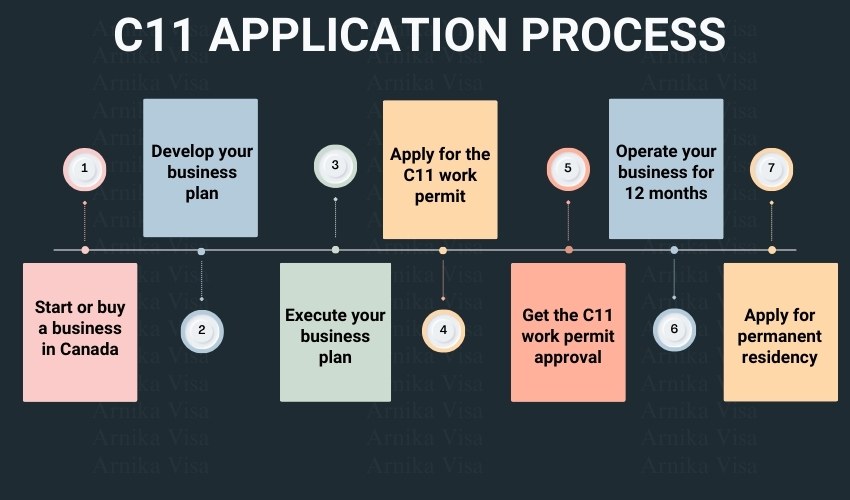
Although every application is unique, the process generally follows several key stages.
Step 1: Assess Your Eligibility
Before investing time and resources, determine whether the C11 Work Permit is the most appropriate immigration pathway for your situation.
You should evaluate:
- Your business experience.
- Ownership structure.
- Available financial resources.
- Proposed Canadian business.
- Long-term immigration objectives.
Some applicants may discover that another business immigration pathway, such as the Intra Company Transfer (ICT) Work Permit, is better suited to their circumstances.
Step 2: Establish or Purchase a Canadian Business
Applicants generally choose one of two approaches:
- Start a new Canadian business.
- Purchase an existing Canadian business.
Regardless of the option selected, the business should have a realistic commercial strategy and demonstrate its potential to provide a significant benefit to Canada.
Step 3: Prepare Your Business Plan
A professional business plan should clearly explain:
- Business objectives.
- Products or services.
- Target market.
- Marketing strategy.
- Financial forecasts.
- Hiring plans.
- Operational strategy.
- Significant benefit to Canada.
A detailed Immigration business plan often becomes one of the strongest pieces of evidence supporting a C11 application.
Step 4: Gather Supporting Documents
Collect all required business, financial, and personal documents before preparing the application.
Carefully organizing supporting evidence helps immigration officers understand your business proposal and reduces unnecessary delays.
Step 5: Submit Your Application
Once your application package is complete, you may submit your work permit application to Immigration, Refugees and Citizenship Canada (IRCC).
Depending on your country of residence and individual circumstances, you may also be required to:
- Provide biometrics.
- Complete a medical examination.
- Submit additional supporting documents.
IRCC will review the application and may request further information before making a final decision.
Can I Apply for a C11 Visa Canada from Inside Canada?
Yes. Depending on your immigration status and eligibility, some foreign nationals may apply for a C11 Work Permit Canada from inside Canada, while others must apply from outside the country.
Eligibility depends on several factors, including your current immigration status, the work permit category, and IRCC requirements.
Because every situation is different, applicants should determine the correct application process before submitting their work permit application.
Can I Bring Employees Under the C11 Work Permit?
The C11 Visa Canada is intended for entrepreneurs who will actively operate their own business in Canada.
If your business grows, you may eventually hire Canadian citizens, permanent residents, or eligible foreign workers. However, additional immigration requirements may apply when hiring foreign nationals.
The C11 Work Permit is designed for business owners—not as a general work permit for company employees.
C11 Work Permit Processing Time
The Canada business visa processing time for a C11 Work Permit Canada depends on several factors, including:
- Your country of residence
- Current IRCC processing volumes
- Whether biometrics are required
- Medical examination requirements
- Completeness of your application
- Requests for additional documents
Submitting a complete application with a detailed business plan and organized supporting documents may help reduce unnecessary delays.
For the latest estimated processing times, applicants should always check the official IRCC website before submitting their application.
Can a C11 Work Permit Lead to Permanent Residence?
The C11 Work Permit does not automatically provide permanent residence. However, many entrepreneurs later become eligible through Express Entry or Provincial Nominee Programs after gaining Canadian work and business experience.
Eligibility depends on many factors, including:
- Canadian work experience.
- Language ability.
- Education.
- Age.
- Business success.
- Individual immigration profile.
The C11 Work Permit itself does not automatically lead to permanent residence, but it can provide valuable Canadian experience that may strengthen future immigration applications.
If your long-term goal is permanent residence through business ownership, our Canada Business Immigration Guide explains the available federal and provincial pathways.
Can My Family Come With Me?
Yes, in many cases.
Eligible family members may accompany you while you operate your Canadian business.
Depending on their circumstances:
- Your spouse or common-law partner may qualify for an Open Work Permit.
- Dependent children may be eligible to attend public elementary or secondary schools in Canada.
- Family members may also qualify for provincial healthcare coverage, depending on the province and local eligibility requirements.
These benefits make the C11 Work Permit an attractive option for entrepreneurs relocating with their families.
Common Reasons C11 Work Permit Applications Are Refused
While many C11 applications are approved, refusals often occur because applicants fail to provide sufficient evidence supporting their business proposal or eligibility.
Some of the most common refusal reasons include:
- Failure to demonstrate a significant benefit to Canada.
- Weak or unrealistic business plan.
- Insufficient financial resources.
- Limited business or management experience.
- Inadequate supporting documentation.
- Passive investment with no active management role.
- Weak evidence of business ownership.
- Failure to satisfy temporary intent requirements.
- Inconsistent information throughout the application.
A carefully prepared application that clearly addresses each eligibility requirement can significantly improve the likelihood of approval.
How to Avoid a C11 Visa Canada Refusal
Many refusals occur because applicants submit strong business ideas but fail to provide sufficient evidence.
To improve your chances of approval:
- Prepare a detailed and realistic business plan.
- Clearly explain the significant benefit your business will bring to Canada.
- Demonstrate relevant business or management experience.
- Provide complete financial evidence.
- Include supporting documents that match your business proposal.
- Ensure all information throughout the application is consistent.
A well-prepared application is far more likely to satisfy an IRCC officer than a generic business proposal.
Why Choose the C11 Work Permit?
For many entrepreneurs, the C11 Work Permit offers one of the most flexible business immigration pathways to Canada.
Unlike many immigration programs that require employer sponsorship or provincial nomination before entering Canada, the C11 category allows qualified business owners to establish or purchase a business and actively manage its operations while living in Canada.
The program is particularly attractive for entrepreneurs who:
- Want to launch a new Canadian business.
- Wish to purchase an existing Canadian business.
- Plan to expand their international business into Canada.
- Prefer an LMIA-exempt work permit.
- Are looking for a potential pathway toward permanent residence.
When properly prepared, a C11 application allows entrepreneurs to combine their business goals with their long-term immigration objectives.
Frequently Asked Questions About the C11 Work Permit
Is the C11 Visa Canada difficult to obtain?
Approval depends on demonstrating significant benefit to Canada, a viable business plan, sufficient financial resources, and relevant business experience.
Do I need an LMIA for a C11 Work Permit?
No. The C11 Work Permit is exempt from the Labour Market Impact Assessment (LMIA) requirement under Canada’s International Mobility Program.
Is there a minimum investment required?
No. IRCC does not set a minimum investment amount. Applicants must simply show they have enough funds to establish and operate their business successfully.
Can I buy an existing business instead of starting one?
Yes. Purchasing an existing Canadian business is an accepted pathway under the C11 Work Permit if you will actively manage and operate it.
Can I start a completely new business?
Yes. Entrepreneurs may establish a new Canadian business provided they can demonstrate that it is commercially viable and likely to provide a significant benefit to Canada.
Can my spouse work in Canada?
In many cases, yes. Eligible spouses may qualify for an Open Work Permit while the principal applicant holds a valid C11 Work Permit.
Can my children study in Canada?
Yes. Dependent children may generally attend public elementary or secondary schools, subject to provincial requirements.
Can the C11 Work Permit lead to permanent residence?
Not automatically. However, many entrepreneurs later qualify for permanent residence through Express Entry or Provincial Nominee Programs after gaining Canadian business experience.
Can I renew my C11 Work Permit?
Yes. If your business continues operating successfully and you remain eligible, your work permit may be extended.
Who Should NOT Apply for the C11 Work Permit?
Although the C11 Visa Canada is an excellent option for many entrepreneurs, it is not suitable for every business owner.
The C11 Work Permit may not be the best immigration pathway if:
- You want to make a passive investment without actively managing the business.
- You have little or no business management experience.
- You cannot demonstrate that your business will provide a significant benefit to Canada.
- Your primary goal is purchasing Canadian real estate rather than operating a business.
- You are looking for a guaranteed pathway to permanent residence, as the C11 Work Permit itself does not automatically lead to PR.
If one of these situations applies to you, another Canadian business immigration program may better fit your long-term goals.
Related Business Immigration Resources
If you’re exploring business immigration options, you may also find these guides helpful:
- Canada Investor Visa: Business Immigration Pathways to Canada
- Intra Company Transfer Canada (ICT Work Permit)
- Business Plan for Canada Business Immigration
- Buy a Business in Canada
Need Professional Assistance With Your C11 Work Permit?
Preparing a successful C11 Work Permit application involves much more than completing immigration forms. Immigration officers carefully assess your business experience, financial capacity, business plan, ownership structure, and the overall benefit your proposed business will bring to Canada.
At Arnika Visa, our licensed RCIC assists entrepreneurs and business owners with every stage of the C11 application process.
Our services include:
- Assessing eligibility for the C11 Work Permit.
- Advising on business immigration strategies.
- Preparing detailed business plans.
- Reviewing supporting documents.
- Preparing and submitting complete work permit applications.
- Providing professional representation before Immigration, Refugees and Citizenship Canada (IRCC).
Whether you’re planning to launch a new business or purchase an existing Canadian company, we can help you build a strong application tailored to your business goals and long-term immigration plans.
Book a consultation today to discuss your Canadian business immigration strategy.
About the Author

Reviewed by Reza Eslami, RCIC (R710241)
Regulated Canadian Immigration Consultant specializing in Canadian business immigration and work permits.
Reza Eslami, RCIC (R710241) is a Regulated Canadian Immigration Consultant (RCIC) and the founder of Arnika Visa, a Canadian immigration consultancy specializing in business immigration, work permits, visitor visas, study permits, and permanent residence applications.