
Alberta’s Foreign Graduate Entrepreneur Stream (FGES) is a provincial immigration pathway for qualified foreign-educated graduates who live outside Canada and want to launch an innovative start-up business in Alberta. The stream combines an Expression of Interest (EOI) selection process with a designated-agency assessment of the business concept.
Applicants need more than an idea. They must meet the education, language, experience, investment, ownership, settlement-fund and business-sector requirements. They also need a recommendation letter from an AAIP-approved designated agency, a business plan with financial projections and a 10-minute pitch deck.
AAIP is currently accepting EOIs under the FGES. Candidates are ranked using the stream’s points grid, and Alberta may invite higher-ranking candidates to submit a Business Application. Meeting the minimum criteria does not guarantee an invitation or nomination.
For an overview of other Canadian business immigration pathways, see Canada Business Immigration.
What Is the Foreign Graduate Entrepreneur Stream?
The FGES is intended for foreign-educated graduates from outside Canada who want to launch a start-up enterprise or innovative business in Alberta. The program is delivered in collaboration with approved designated agencies, which assess entrepreneurial readiness and the proposed business before issuing a recommendation letter.
The designated agency reviews the market need, potential market entry, customer acquisition, business development, key partnerships and financial plan for funding the start-up. Its written assessment of the proposed business plan must also be submitted with the Business Application.
This stream is distinct from Alberta’s Graduate Entrepreneur Stream, which is designed for international graduates of eligible Alberta post-secondary institutions. Applicants should not confuse the two streams.
Official program information: Alberta Foreign Graduate Entrepreneur Stream.
Who May Qualify? Main Eligibility Requirements
The current AAIP eligibility page sets out the following core requirements. Applicants should review the official page and points grid because some criteria are mandatory minimums while other factors contribute points.
1. Foreign Education and Educational Credential Assessment
You must have completed a degree at a post-secondary institution outside Canada within the 10 years before submitting your EOI. An Educational Credential Assessment (ECA) must confirm that the foreign credential is equivalent to a Canadian degree.
2. Relevant Work or Business Experience
You must have at least six months of full-time experience. The program allows a combination of actively managing or owning a business or qualifying equivalent experience with a business incubator or accelerator. Additional experience may increase your points.
3. Language Proficiency
You must meet at least CLB 5 in each of the four English language skills, or NCLC 5 in each French skill. Test results must be less than two years old when the EOI is submitted. The current AAIP page lists CELPIP-General, IELTS-General Training, PTE, TEF Canada and TCF Canada as accepted tests.
4. Business Plan and Financial Projections
A business plan with projected financial information is mandatory. It should explain the product or service, target market, customer problem, competitive position, business model, go-to-market strategy, key partnerships, operating plan, funding requirements and financial forecasts.
5. Ten-Minute Pitch Deck
A 10-minute presentation using slides only is mandatory. It should explain the founder and venture in a format that addresses the questions an investor would want answered: what is being built, why the market needs it, how customers will be acquired, how the business will make money and what resources are needed.
6. Designated-Agency Recommendation
You must work with an AAIP-approved designated agency. If the agency considers the applicant and business concept suitable, it may issue a letter of recommendation. The letter must be submitted with the EOI. The agency also prepares a written assessment of the business plan for the Business Application.
7. Investment and Ownership
The mandatory minimum investment must come from the candidate’s own equity or qualifying funding from a recognized Canadian financial institution, venture capital firm or angel investment firm, as described by AAIP. The minimum is:
- CAD $100,000 for a business in an urban centre (Calgary or Edmonton Census Metropolitan Areas).
- CAD $50,000 for a business in a regional area outside the Calgary and Edmonton Census Metropolitan Areas.
You must own at least 34% of the business in an urban centre or at least 51% in a regional area. Business partners must be Canadian citizens or permanent residents. Higher investment may earn additional points.
8. Settlement Funds
You must show that you have sufficient funds to establish the business and support yourself and your family while you are in Alberta on a work permit. AAIP calculates the minimum using family size and the population size of the intended community, based on its published settlement-funds table. Check the current table at the time of EOI submission; do not rely on older LICO figures copied into third-party articles.
9. Business Sector and Physical Presence
The business plan or pitch deck must connect the proposed business to one of the sectors listed by AAIP: technology, aerospace, financial services, energy, agriculture, tourism, life sciences or pharmaceuticals.
The business must have a physical place of business in Alberta. You must reside in Alberta and take part in the day-to-day management. Remote management from another province, territory or country does not meet the program’s stated owner-operator expectation.
Eligible Business Sectors
The FGES is intended for innovative start-ups connected to one or more of the following sectors:
- Technology
- Aerospace
- Financial services
- Energy
- Agriculture
- Tourism
- Life sciences
- Pharmaceuticals
The sector label alone is not enough. AAIP assesses whether the proposed business can create economic benefit in Alberta and whether the applicant has the capacity to establish, manage and sustain it.
Businesses That May Be Ineligible
The official AAIP eligibility page lists business models that may be ineligible. Examples include:
- Passive investment businesses or immigration-linked investment schemes.
- Businesses without a value-added economic component, including payday lending and cheque-cashing businesses.
- Businesses trading in used goods.
- Passive businesses or businesses lacking active management, including certain insurance or business brokerages.
- Project-based or seasonal businesses.
- Home-based businesses that are not zoned for commercial or industrial operations, including bed-and-breakfasts and lodging houses.
- Businesses that are part of a succession plan.
- Businesses involving pornography, sexually explicit products or services, or sexually oriented services.
This is not a substitute for the full official list. Confirm the proposed business’s eligibility before paying an agency, signing a lease or making an investment.
AAIP-Approved Designated Agencies
Applicants must work with one of the designated agencies currently listed by Alberta. The official AAIP page identifies:
Elite Global Group Ltd.
Located in Edmonton, Alberta. The agency assesses entrepreneurial readiness and proposed business concepts for the FGES.
Empowered Startups
Located in Vancouver, British Columbia. The agency works with foreign graduates on business assessment and start-up development.
Platform Calgary
Located in Calgary, Alberta. The organization connects founders with Calgary’s innovation and business ecosystem.
Agency acceptance, assessment procedures, service scope, fees and timelines are determined by the agency. They are not government application fees and should be reviewed carefully before entering into an agreement.
Confirm the current agency list on the official FGES eligibility page.
How the FGES Points System Works
The EOI is assessed using a points grid with a maximum of 200 points. The current grid includes human-capital factors and business factors. It awards points for language proficiency, education, business ownership or management experience, the business plan, investment before coming to Alberta, additional proposed investment after launch and job creation.
The points grid also includes mandatory pass/fail items. These include the required ownership share, connection to an eligible sector, settlement funds, pitch deck and designated-agency recommendation. A high points score does not remove the need to satisfy mandatory requirements.
AAIP selects candidates from the EOI pool. The province may invite higher-ranking candidates to submit a Business Application, but there is no guarantee that a particular score will result in an invitation.
Because points tables can be revised, applicants should use the current AAIP points grid rather than relying on a static score chart copied from an older article.
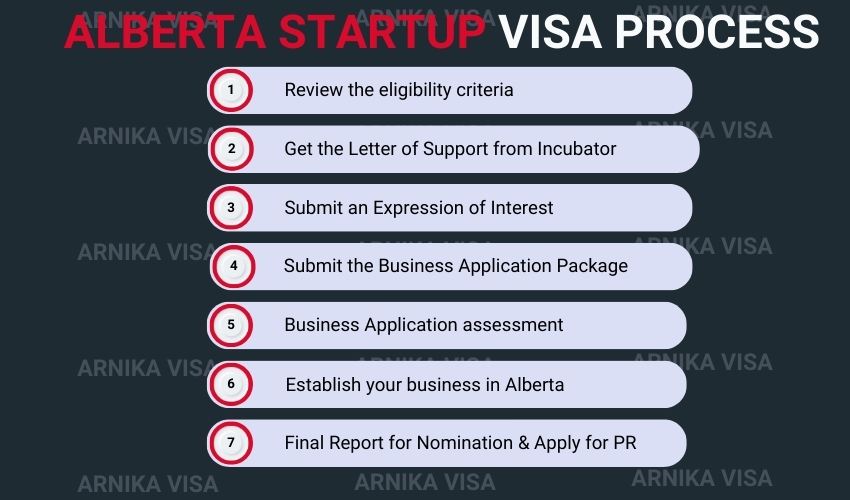
Application Process: From Designated Agency to Permanent Residence
Step 1: Assess Your Eligibility
Review the education, ECA, work experience, language, investment, ownership, settlement funds and sector requirements. Confirm that you are applying under the correct stream and that your proposed business is eligible.
Step 2: Contact an Approved Designated Agency
Approach an AAIP-approved agency with information about your background, business concept, market opportunity and funding plan. The agency assesses entrepreneurial readiness and the potential for the business to succeed.
Step 3: Develop the Business Plan and Pitch Deck
Prepare a detailed business plan with projected financials and a 10-minute slide presentation. The proposal should demonstrate market need, customer acquisition, business development, key partnerships and the resources required to fund the start-up.
Step 4: Obtain the Recommendation Letter
If the designated agency supports the applicant and business proposal, it may issue a recommendation letter. The agency also provides a written assessment of the proposed business plan for submission with the Business Application.
Step 5: Submit the Expression of Interest
Submit the EOI through the AAIP Portal with the required information and supporting material, including the business plan, pitch deck, net-worth worksheet and designated-agency recommendation. AAIP scores and ranks the EOI using the current points grid.
Step 6: Receive an Invitation and Submit the Business Application
If selected, you may receive an invitation or request to submit a Business Application. Follow the deadline and checklist in the invitation. The application may require formal financial verification and the designated agency’s business-plan assessment, in addition to evidence of education, language and experience.
Step 7: Business Application Assessment and Performance Agreement
AAIP assesses the application and verifies the EOI information. If approved, the applicant receives a Business Performance Agreement setting out the commitments that must be fulfilled. Review the agreement carefully and obtain independent legal advice before signing.
Step 8: Work Permit Application
After the required agreement and support letter are issued, the applicant may apply to IRCC for a temporary work permit. The provincial support letter does not itself grant work authorization. IRCC independently assesses the work permit application and admissibility.
Step 9: Establish and Operate the Business in Alberta
After receiving the required work authorization, the applicant must move to Alberta, establish the business and fulfil the Performance Agreement. This includes the agreed investment, ownership, business operations and any other commitments. The applicant must actively manage the business and maintain the required Alberta residence.
Step 10: Final Report and Provincial Nomination
When the Performance Agreement requirements have been met, submit the final report and supporting evidence in accordance with AAIP instructions. If the province is satisfied, it may issue a provincial nomination.
Step 11: Apply for Permanent Residence
After nomination, submit the permanent residence application to IRCC within the applicable deadline. IRCC conducts the federal assessment, including admissibility. A provincial nomination does not guarantee permanent residence.
Can Someone Who Already Owns a Business in Alberta Apply?
The official FGES rules also address foreign graduates who already own and operate a business in Alberta. The business must have operated in Alberta for at least one year immediately before the EOI is submitted. The applicant must meet the points-grid and mandatory requirements at the time of EOI submission.
If selected and approved, the applicant is not required to operate the established business for an additional year after applying to AAIP, but must continue operating it while the permanent residence application is processed by IRCC.
Processing Times and Costs
There is no reliable single end-to-end processing time that applies to every FGES applicant. The overall timeline depends on designated-agency assessment, preparation of the business plan and pitch deck, EOI selection, Business Application processing, work permit processing, business establishment and performance reporting, nomination and federal permanent residence processing.
Likewise, the total cost is not limited to a single government fee. Applicants should budget separately for the qualifying business investment, settlement funds, designated-agency services, business-plan preparation, legal and accounting work, government fees, work permit and permanent residence fees, relocation and business operating costs.
Avoid relying on old claims that every applicant will pay a fixed incubator fee or that the program will take a fixed number of months. Obtain current written fee information from the designated agency and check AAIP and IRCC fee schedules before proceeding.
FGES vs. Other Alberta and Canadian Business Immigration Options
FGES vs. Alberta Graduate Entrepreneur Stream
The Foreign Graduate Entrepreneur Stream is for eligible graduates educated outside Canada who are launching an innovative start-up in Alberta and must work with a designated agency. The separate Graduate Entrepreneur Stream is for eligible international graduates of Alberta post-secondary institutions. Their education, work permit, language and business requirements differ.
FGES vs. C11 Work Permit
C11 is a federal LMIA-exempt work permit category that may apply to certain entrepreneurs who will actively develop and direct a business and demonstrate significant benefit to Canada. It is not the same as the FGES and does not use the FGES designated-agency EOI process.
Read our C11 Work Permit Canada guide for the federal pathway.
FGES vs. Intra-Company Transfer
An intra-company transfer may apply when a qualifying multinational company transfers an eligible employee to a related Canadian business. It is not a general start-up or investor pathway.
Read our Intra-Company Transfer Canada guide for the eligibility requirements.
Common Mistakes to Avoid
- Calling FGES a general Alberta Start-Up Visa and assuming any foreign entrepreneur can apply.
- Confusing FGES with the separate Graduate Entrepreneur Stream for Alberta graduates.
- Assuming a business idea in a listed sector automatically qualifies.
- Approaching a non-approved incubator or relying on an agency’s marketing claims without checking the official designated-agency list.
- Underestimating the time and cost of developing a viable product, obtaining customers and establishing the business.
- Using outdated investment, language, education or ownership requirements.
- Treating the recommendation letter as a guarantee of an invitation, nomination or work permit.
- Assuming the provincial support letter automatically authorizes work in Canada.
- Failing to plan for settlement funds, business operating costs and the requirement to reside in Alberta and manage the business actively.
Frequently Asked Questions
Is the Alberta Foreign Graduate Entrepreneur Stream open?
The official AAIP eligibility page currently states that Alberta is accepting EOIs under the Foreign Graduate Entrepreneur Stream. Intake availability can change, so check the official page before preparing an application.
Is FGES the same as the Alberta Start-Up Visa?
The official name is Foreign Graduate Entrepreneur Stream. “Alberta Start-Up Visa” is an informal or historical description and can be misleading because this is a specific provincial stream for foreign-educated graduates.
Can I apply if I studied in Canada?
FGES requires a qualifying degree from a post-secondary institution outside Canada, completed within the last 10 years and supported by an ECA. Graduates of Alberta institutions should examine the separate Graduate Entrepreneur Stream.
How much do I need to invest?
The mandatory minimum is CAD $100,000 in an urban centre or CAD $50,000 in a regional area outside the Calgary and Edmonton Census Metropolitan Areas. Higher investment may earn additional points. You must also plan for operating costs and settlement funds.
What ownership percentage is required?
At least 34% in an urban centre or at least 51% in a regional area. The business must meet the other eligibility requirements as well.
Do I need a designated agency?
Yes. You must obtain a recommendation letter from an AAIP-approved designated agency and submit the required business-plan assessment with your Business Application.
What language score do I need?
At least CLB 5 in each English skill or NCLC 5 in each French skill. The accepted tests and validity rules are listed on the current AAIP page.
Do I need a business plan and pitch deck?
Yes. A business plan with financial projections and a 10-minute slide-only pitch deck are mandatory.
Does the FGES guarantee permanent residence?
No. AAIP must first select and approve the applicant, the applicant must fulfil the Performance Agreement and receive nomination, and IRCC must then approve the permanent residence application.
Can I apply if I already operate a business in Alberta?
The official rules allow certain foreign graduates with an established Alberta business to apply. The business must have operated in Alberta for at least one year immediately before EOI submission, and the applicant must meet the current points-grid and mandatory requirements.
Can my spouse and children accompany me?
Family members may be included or may apply for temporary status subject to the applicable IRCC rules. Work and study authorization for family members is assessed separately and is not automatic.
Is FGES part of Express Entry?
The FGES uses an AAIP Expression of Interest and provincial nomination process. It is not an Express Entry stream.
How Arnika Visa Can Help
The FGES requires coordinated business and immigration planning. Arnika Visa can help assess whether the applicant’s education, experience, business concept and immigration objectives may align with the stream, and can assist with immigration strategy and application preparation within the agreed scope of representation.
- Reviewing the applicant’s immigration background and potential stream fit
- Assessing the proposed business concept against the published immigration criteria
- Coordinating immigration-focused business-plan requirements and supporting evidence
- Reviewing the designated-agency process and required immigration documents
- Preparing and representing the client in relevant immigration applications, where retained
Designated agencies independently assess and recommend business concepts. Arnika Visa cannot guarantee that an agency will accept a proposal, that AAIP will issue an invitation or nomination, or that IRCC will approve a work permit or permanent residence.
Explore our Canada Business Immigration services or book a consultation with Reza Eslami, RCIC R710241.
Related Resources
- Canada Business Immigration
- C11 Work Permit Canada
- Intra-Company Transfer Canada
- Canada Immigration Business Plan
Official Government Resources
- Foreign Graduate Entrepreneur Stream – Eligibility
- Foreign Graduate Entrepreneur Stream – How to Apply
- Foreign Graduate Entrepreneur Stream – Program Overview
- AAIP Updates
Last reviewed: November 2026. AAIP criteria, designated agencies, fees, points and intake availability may change. Confirm the current Government of Alberta instructions before acting.
About the Author
Reza Eslami is a Regulated Canadian Immigration Consultant (RCIC, R710241) specializing in Canadian business immigration. He advises entrepreneurs, investors and international business owners on provincial entrepreneur pathways, C11 work permits, intra-company transfers, business acquisitions and Canadian immigration planning.