

Canada is one of the world’s most attractive destinations for entrepreneurs, investors, and international businesses looking to expand into a stable and innovative economy. Before investing, purchasing a business, attending important meetings, or exploring commercial opportunities, many foreign business professionals first enter Canada as business visitors.
A business visitor to Canada is a foreign national who travels to Canada temporarily for qualifying international business activities without entering the Canadian labour market. Depending on your nationality and how you travel, you may need a Temporary Resident Visa (TRV) or an Electronic Travel Authorization (eTA).
Business visitors commonly travel to Canada to:
- Attend meetings with Canadian companies
- Explore business investment opportunities
- Conduct market research
- Visit potential franchise locations
- Inspect businesses for sale
- Negotiate contracts
- Participate in trade shows and conferences
- Meet lawyers, accountants, and business advisors
- Receive limited business-related training
For entrepreneurs planning to establish or acquire a Canadian business, a business visitor trip is often the first step before applying for a work permit or business immigration program.
This guide explains who qualifies as a business visitor, what activities are permitted, how to apply, common mistakes to avoid, and how a business visit can support your long-term business goals in Canada.
If your long-term objective is to establish, purchase, or expand a business in Canada, we recommend starting with our complete guide to Canada Business Immigration, which explains the entrepreneur pathways available to foreign investors and business owners.
Planning to establish or purchase a business in Canada? Before making your investment, explore our complete guide to Canada Business Immigration to understand the available pathways for entrepreneurs and investors.
Key Takeaway
A business visitor can conduct qualifying temporary business activities in Canada without entering the Canadian labour market. If your plans involve actively working for or operating a Canadian business, you may need a work permit.
Last updated: August 2026
Reviewed by Reza Eslami, RCIC (R710241)
Reading time: 8 minutes

What Is a Business Visitor Visa Canada?
A Business Visitor Visa allows eligible foreign nationals to travel to Canada temporarily for business-related activities without becoming part of the Canadian workforce.
Unlike foreign workers, business visitors continue working primarily for an employer or business located outside Canada. Their salary, profits, and principal place of business remain outside the country while they conduct temporary business activities during their visit.
Business visitors generally enter Canada for a limited period to develop commercial relationships, explore investment opportunities, or participate in international business activities that benefit companies operating outside Canada.
Depending on your nationality, you may require either:
- a Temporary Resident Visa (TRV) before travelling to Canada, or
- an Electronic Travel Authorization (eTA) if you are visa-exempt and travelling by air.
Receiving a Business Visitor Visa or entering Canada as a business visitor does not authorize you to work for a Canadian employer or receive employment income from a Canadian business. Understanding this distinction is essential because engaging in unauthorized work may result in refusal of entry or future immigration complications.
If your intention is to actively operate a Canadian business instead of simply exploring opportunities, you will likely require a work permit rather than business visitor status. Our guide to the C11 Work Permit Canada explains when entrepreneurs may qualify to establish or purchase and actively manage a Canadian business.
Who Qualifies as a Business Visitor?
To qualify as a business visitor, you must demonstrate that your trip is temporary and that your primary business activities remain outside Canada.
Although each application is assessed individually, immigration officers generally expect applicants to satisfy several important requirements.
You plan to stay in Canada for less than six months and to demonstrate that:
- Your primary place of business is outside Canada.
- Your employer or business is located outside Canada.
- Your primary source of income remains outside Canada.
- You intend to stay temporarily.
- You will leave Canada at the end of your authorized stay.
- You have sufficient financial resources for your visit.
- You possess a valid passport or travel document.
- You meet Canada’s general admissibility requirements.
Business visitors are expected to maintain strong ties to their country of residence through employment, business ownership, family commitments, or other significant connections that demonstrate their intention to return home after completing their business activities.
Immigration officers evaluate each application based on the traveller’s overall circumstances rather than relying on a single factor.
What Business Activities Are Permitted?
One of the most common questions entrepreneurs ask is:
“What can I legally do in Canada as a business visitor?”
Fortunately, business visitors may engage in a wide range of commercial activities, provided they do not directly enter the Canadian labour market.
Common permitted activities include:
Attend Business Meetings
Meeting with Canadian suppliers, partners, investors, distributors, or clients is one of the most common reasons entrepreneurs travel to Canada.
These meetings may involve discussing future business relationships, negotiating commercial agreements, or evaluating partnership opportunities.
Explore Business Opportunities
Many foreign entrepreneurs visit Canada before deciding whether to invest.
During a business visit, you may:
- Explore industries
- Research local markets
- Evaluate potential investments
- Meet business brokers
- Visit commercial properties
- Assess economic opportunities
This preliminary research often helps entrepreneurs determine whether Canada is the right market for future expansion.
Inspect Businesses for Sale
Many international investors travel to Canada before purchasing an existing business.
A business visitor may:
- Meet the business owner
- Review operations
- Visit business premises
- Meet accountants
- Consult lawyers
- Conduct preliminary due diligence
These activities allow buyers to make informed investment decisions before proceeding with a business acquisition. Our complete guide to Buy a Business in Canada explains every stage of the acquisition process, from finding opportunities to conducting due diligence and completing the purchase.
Considering acquiring an existing company? Our step-by-step guide to Buy a Business in Canada explains how to evaluate businesses, conduct due diligence, and complete a successful purchase.
Explore Franchise Opportunities
Canada has a well-developed franchise sector across industries such as food services, retail, education, fitness, and commercial services.
Business visitors frequently travel to Canada to:
- Meet franchisors
- Visit existing franchise locations
- Review franchise disclosure documents
- Meet franchise consultants
- Evaluate investment opportunities
Exploring a franchise before making an investment can significantly reduce business risk. If you’re considering franchise ownership, our step-by-step guide to Buying a Franchise in Canada explains how to evaluate franchise systems, review disclosure documents, and choose the right opportunity.
Interested in franchise ownership? Learn more in our comprehensive guide to Buying a Franchise in Canada.
Attend Trade Shows and Conferences
Business visitors may attend:
- Industry conferences
- Trade exhibitions
- Networking events
- Product launches
- Professional seminars
These events allow international businesses to build commercial relationships and better understand the Canadian marketplace.
Many entrepreneurs use trade shows and industry conferences to evaluate potential suppliers, meet franchisors, and explore investment opportunities before deciding whether to purchase an existing business or establish a new one in Canada.
Negotiate Contracts
Business visitors may negotiate commercial agreements with Canadian businesses provided they remain employed and paid outside Canada.
Typical activities include:
- Supplier negotiations
- Distribution agreements
- Investment discussions
- Partnership agreements
- Service contracts
Negotiating future business arrangements is generally consistent with business visitor status.
When Do You Need a Work Permit Instead?
If your activities involve performing productive work for a Canadian company, carrying out managerial, technical or production duties, or actively operating a Canadian business, you may need a work permit rather than relying on business visitor status. IRCC assesses the nature of your activities and circumstances when determining whether the business visitor exemption applies.
Entrepreneurs considering purchasing or establishing a Canadian business should review our C11 Work Permit Canada guide before making a major investment.
What Activities Are NOT Allowed as a Business Visitor?
Although business visitors may participate in many commercial activities, they cannot enter the Canadian labour market without the appropriate authorization.
In simple terms, if your activities involve performing productive work for a Canadian employer or operating a Canadian business on a day-to-day basis, you will generally require a work permit rather than business visitor status.
Examples of activities not normally permitted include:
- Working directly for a Canadian employer
- Receiving a salary or wages from a Canadian company for work performed in Canada
- Providing services that compete directly in the Canadian labour market
- Managing the daily operations of a Canadian business that you own or have purchased
- Performing hands-on work at a Canadian business location
- Replacing or filling a position that could otherwise be performed by a Canadian worker
Managing or performing day-to-day operational work for a Canadian business may require a work permit. The key question is whether your activities fall within the business visitor provisions or constitute work in the Canadian labour market.
Understanding these limitations is essential before travelling to Canada. Engaging in unauthorized work can result in refusal of entry, cancellation of your visitor status, or future immigration complications.
If your plans involve actively operating or managing a Canadian business, you should determine whether a work permit is required before travelling. Entrepreneurs planning to purchase and actively operate a Canadian business should review the C11 Work Permit Canada requirements before making their investment.
Planning to actively manage a Canadian business? Learn whether the C11 Work Permit Canada may be a more appropriate option for entrepreneurs.
Business Visitor vs. Tourist: What's the Difference?
Many travellers mistakenly assume that a tourist visa and a business visitor visa are the same.
While both allow temporary entry into Canada, their intended purposes are very different.
| Business Visitor | Tourist Visitor |
|---|---|
| Attend business meetings | Vacation and tourism |
| Explore investment opportunities | Visit family or friends |
| Negotiate commercial contracts | Sightseeing |
| Attend conferences and trade shows | Recreational activities |
| Conduct market research | Personal travel |
| Meet business partners | Holiday travel |
Business visitors travel primarily for commercial purposes while maintaining employment or business operations outside Canada.
Tourists travel primarily for leisure, family visits, or personal reasons.
Regardless of the purpose of travel, both visitors must satisfy Canada’s admissibility requirements and demonstrate that they intend to leave Canada before the end of their authorized stay.
Business Visitor vs. C11 Work Permit vs. ICT Work Permit
Entrepreneurs often ask whether they should enter Canada as a business visitor or apply directly for a work permit.
The answer depends on the purpose of the trip.
The following comparison summarizes the key differences.
Feature | Business Visitor | C11 Work Permit | ICT Work Permit |
|---|---|---|---|
| Purpose | Temporary business activities | Establish or purchase and actively operate a Canadian business | Transfer to a Canadian branch, subsidiary, or affiliate |
| Work Permit Required | No | Yes | Yes |
| Can Manage Daily Operations | No | Yes | Yes |
| Can Receive Canadian Employment Income | Generally No | Yes | Yes |
| Typical Length of Stay | Temporary | Based on work permit validity | Based on work permit validity |
| Best For | Market research, meetings, due diligence | Entrepreneurs establishing or purchasing businesses | Multinational companies transferring executives or specialized employees |
Choosing the right immigration pathway depends on your business goals. The C11 Work Permit is for eligible entrepreneurs seeking to establish or operate a business in Canada that provides significant economic, social, or cultural benefit, while multinational companies expanding into Canada frequently use the ICT Work Permit Canada.
Do I Need a Visa to Visit Canada for Business?
Whether you need a visitor visa or an eTA depends on your nationality, travel document and how you travel to Canada. Visa-required travellers generally need a TRV, while eligible visa-exempt travellers flying to Canada generally need an eTA. You should check the official IRCC requirements before travelling.
How to Apply for a Business Visitor Visa Canada
The application process depends largely on your nationality.
Citizens of visa-required countries generally need to apply for a Temporary Resident Visa (TRV) before travelling.
Travellers from visa-exempt countries may instead require an Electronic Travel Authorization (eTA) when travelling to Canada by air.
Regardless of the document required, applicants should be prepared to demonstrate the purpose of their business trip and satisfy Canadian immigration officers that they meet all entry requirements.
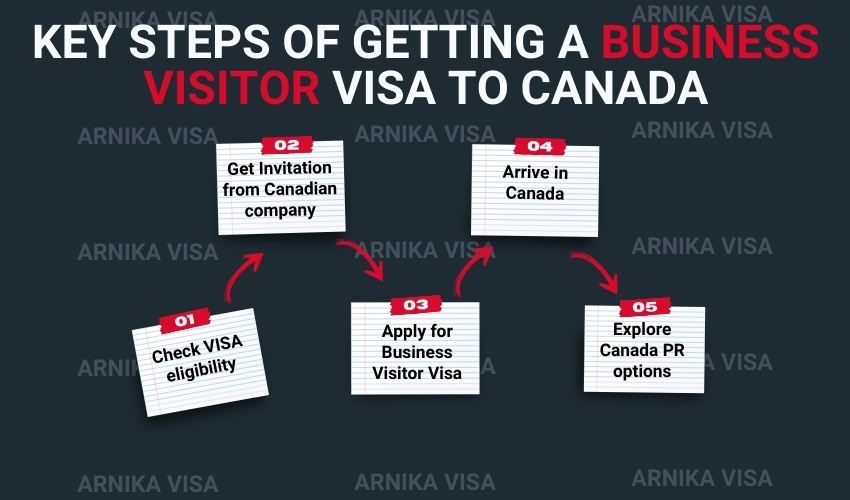
The typical application process includes the following steps.
Determine whether your nationality requires:
- a Temporary Resident Visa (TRV), or
- an Electronic Travel Authorization (eTA).
Step 2: Gather Supporting Documents
Prepare documents demonstrating:
- Your business purpose
- Your employment or business outside Canada
- Financial ability to support your stay
- Strong ties to your home country
- Your intention to leave Canada after your visit
Step 3: Submit Your Application
Applications are generally submitted online through Immigration, Refugees and Citizenship Canada (IRCC), although some applicants may use a Visa Application Centre (VAC) where required.
Step 4: Provide Biometrics (if required)
Depending on your nationality, you may be asked to provide fingerprints and a photograph.
Step 5: Wait for Processing
Processing times vary depending on your country of residence, application volume, and individual circumstances.
Applicants should apply well in advance of their intended travel date.
Documents You May Need
Supporting documentation plays an important role in demonstrating that your visit qualifies under Canada’s business visitor provisions.
Common documents include:
- Valid passport
- Business invitation letter (if applicable)
- Employer confirmation letter
- Company registration documents
- Evidence of your business activities outside Canada
- Conference or trade show registration
- Travel itinerary
- Hotel reservations
- Return travel arrangements
- Bank statements or financial evidence
- Previous travel history (where available)
- Proof of the relationship with the Canadian company or business contacts, where applicable.
Immigration officers may request additional documents depending on the purpose of your trip and your individual circumstances. For entrepreneurs planning to purchase a business or apply for a work permit after their visit, preparing a professional Canada Immigration Business Plan early in the process can strengthen both business planning and future immigration applications.
Business Invitation Letter
A well-prepared invitation letter from the Canadian company or organization you intend to visit can strengthen your application.
A typical invitation letter may include:
- Name of the inviting company
- Contact information
- Purpose of the visit
- Planned business activities
- Duration of the visit
- Signature of the inviting representative
- A clear description of the business activities planned in Canada and, where relevant, confirmation that the visitor’s activities do not involve entering the Canadian labour market.
An invitation letter does not guarantee visa approval, but it helps immigration officers understand the legitimate commercial purpose of your trip.
Common Reasons Business Visitor Visa Applications Are Refused
Although many business visitor applications are approved, some are refused because applicants do not clearly demonstrate that they meet Canada’s temporary entry requirements. Understanding the most common reasons for refusal can help you prepare a stronger application.
If your business visitor application has already been refused, see our Canada Visa Refusal guide to understand your options after a refusal.
1. Unclear Purpose of Visit
Officers need to understand both why you are travelling to Canada and why the trip is temporary. Your itinerary, invitation, business documents and evidence of your ongoing activities outside Canada should tell a consistent story. The more clearly you explain your planned activities, the easier it is for an officer to assess your application.
2. Insufficient Evidence of Business Activities
Applicants should demonstrate that they are actively engaged in business outside Canada.
Helpful supporting documents include:
- Company registration documents
- Business licences
- Employment confirmation letters
- Corporate tax documents
- Business cards
- Company website
- Client contracts
These documents help establish your professional background and demonstrate that your primary business activities remain outside Canada.
3. Weak Ties to Your Home Country
Business visitors must convince immigration officers that they intend to leave Canada at the end of their authorized stay.
Evidence of strong ties may include:
- Ongoing employment
- Business ownership
- Family responsibilities
- Property ownership
- Financial commitments
- Previous international travel
Strong home-country ties often strengthen temporary resident applications.
4. Financial Concerns
Applicants should demonstrate that they can financially support themselves during their stay in Canada.
Depending on the purpose of the visit, officers may review:
- Bank statements
- Business financial records
- Employer support letters
- Corporate sponsorship
- Proof of accommodation
- Return travel arrangements
5. Inconsistent Information
All supporting documents should be consistent.
Differences between:
- invitation letters
- application forms
- travel itinerary
- employer letters
may create unnecessary concerns during the assessment.
Carefully reviewing your application before submission can help avoid preventable delays or refusals.
What Happens After Your Business Visit?
For many entrepreneurs, a business visit is only the beginning of a much larger investment journey.
During their visit, entrepreneurs often:
- Meet business brokers
- Inspect businesses for sale
- Visit franchise locations
- Consult accountants and lawyers
- Conduct market research
- Evaluate commercial properties
- Meet immigration professionals
After returning home and completing their research, many investors decide to move forward with a Canadian business investment.
Depending on their goals, entrepreneurs may decide to purchase an existing Canadian business, invest in a franchise, establish a new company, or expand an international business into Canada.
If you’re still deciding between these options, our comparison guide Buy, Start, or Franchise a Business in Canada explains the advantages, challenges, and investment considerations of each approach.
Frequently Asked Questions
Do I need a Business Visitor Visa to attend meetings in Canada?
It depends on your nationality. Some travellers require a Temporary Resident Visa (TRV), while others only need an Electronic Travel Authorization (eTA). Regardless of the travel document required, you must qualify as a genuine business visitor.
Can I buy a business while visiting Canada?
Yes. Business visitors may generally explore investment opportunities, inspect businesses, conduct due diligence, negotiate purchases, and meet professional advisors. However, actively operating the business may require a work permit.
Our detailed Buy a Business in Canada guide explains how to evaluate businesses, conduct due diligence, negotiate the purchase, and prepare for ownership.
Can I buy a franchise as a business visitor?
Yes. Many international entrepreneurs travel to Canada to meet franchisors, review franchise disclosure documents, visit existing franchise locations, and evaluate investment opportunities before purchasing a franchise.
Before investing, international entrepreneurs should also review our guide to Buying a Franchise in Canada as a Foreigner, which explains ownership, financing, immigration, and legal considerations.
Can I work while holding Business Visitor status?
No. Business visitors cannot enter the Canadian labour market or perform work that normally requires a work permit.
Can I receive payment from a Canadian company?
Generally, business visitors continue to receive their salary or business income from outside Canada. Receiving employment income from a Canadian employer may require work authorization.
How long can I stay in Canada as a business visitor?
Most visitors can stay in Canada for up to six months, but the border services officer may authorize a shorter or longer period depending on the circumstances. The date you must leave will be determined by your authorized status or visitor record.
Can I later apply for a Canadian work permit?
Depending on your circumstances and eligibility, you may be able to apply for a work permit. However, business visitor status does not itself give you work authorization, and entering Canada as a business visitor does not guarantee that you will qualify for a work permit later.
Should I consult an immigration professional before investing?
For entrepreneurs planning a significant business investment, obtaining professional legal and immigration advice before purchasing a business or franchise can help avoid costly mistakes.
Continue Your Business Immigration Journey
If you’re planning to establish or expand a business in Canada, these guides may also help:
- Canada Business Immigration — Explore Canada’s entrepreneur and investor immigration pathways.
- Buy a Business in Canada — Learn how to acquire an existing Canadian business.
- Buying a Franchise in Canada — Understand the franchise buying process from start to finish.
- Buying a Franchise in Canada as a Foreigner — Immigration and investment guidance for international entrepreneurs.
- C11 Work Permit Canada — Discover one of Canada’s most flexible entrepreneur work permit options.
- ICT Work Permit Canada — Learn how multinational companies transfer executives and key employees.
- Canada Immigration Business Plan — Understand why a professional business plan is essential for many entrepreneur applications.
How Arnika Visa Can Help
Entering Canada as a business visitor is often the first step toward a successful business expansion or investment. Whether you plan to purchase a business, invest in a franchise, or establish a new company, understanding the correct immigration strategy before committing to an investment can save time, reduce risk, and improve your long-term prospects.
At Arnika Visa, we help entrepreneurs at every stage of their Canadian business journey—from exploratory business visits and market research to purchasing businesses, developing immigration business plans, and applying for business immigration programs such as the C11 Work Permit Canada and ICT Work Permit Canada.
Our goal is to help you develop a business and immigration strategy that aligns with your commercial objectives while ensuring compliance with Canadian immigration requirements.
Book a consultation today to discuss your Canadian business expansion plans.

About the Author

Reviewed by Reza Eslami, RCIC (R710241)
Regulated Canadian Immigration Consultant specializing in Canadian business immigration and work permits.
Reza Eslami is a Regulated Canadian Immigration Consultant (RCIC) specializing in Canadian business immigration. He advises entrepreneurs, investors, and multinational companies on business visitor travel, business acquisitions, C11 Work Permits, Intra-Company Transfers, entrepreneur immigration, and business expansion into Canada.