

Canada has long recognized that entrepreneurs play an important role in strengthening the country’s economy. By establishing new businesses, creating jobs, introducing innovation, and investing in local communities, experienced business owners contribute to economic growth across the country. To attract qualified entrepreneurs, several Canadian provinces operate Entrepreneur Immigration Programs through their Provincial Nominee Programs (PNPs). These programs are designed for experienced business owners and senior managers who are willing to invest in and actively manage a business within a specific province.
Unlike traditional economic immigration programs that focus primarily on skilled workers, Entrepreneur Immigration Programs evaluate applicants based on their business experience, investment capacity, management skills, and commitment to operating a successful Canadian business.
For many entrepreneurs, these programs represent a long-term pathway that may eventually lead to Canadian permanent residence after meeting provincial requirements and successfully operating their business.
However, every province has its own eligibility criteria, investment thresholds, business requirements, and nomination process. Understanding these differences before investing is essential to selecting the most appropriate immigration pathway.
In this guide, you’ll learn how Entrepreneur Immigration Canada works, who qualifies, how Provincial Entrepreneur Programs operate, the application process, common eligibility requirements, and how these programs compare with other Canadian business immigration options.
Last updated: August 2026
Reviewed by Reza Eslami, RCIC (R710241)
Reading time: 12 minutes
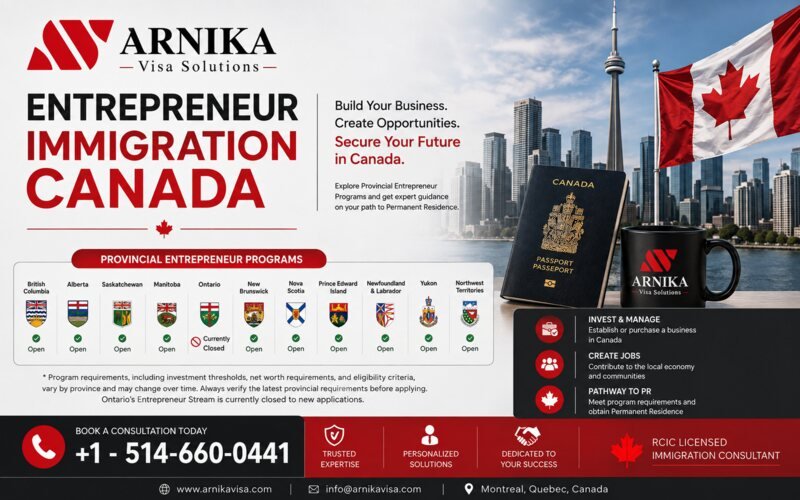
Table of Contents
- What Is Entrepreneur Immigration Canada?
- Who Is Entrepreneur Immigration Designed For?
- Entrepreneur Immigration Canada Requirements
- How Much Money Do You Need for Entrepreneur Immigration Canada?
- Entrepreneur Immigration vs. C11 Work Permit vs. ICT Work Permit
- Can Entrepreneur Immigration Lead to Permanent Residence?
- Provincial Entrepreneur Immigration Programs in Canada
- How to Choose the Right Province
- Can I Buy an Existing Business for Entrepreneur Immigration Canada?
- How the Entrepreneur Immigration Process Works
- How Immigration Authorities Assess Entrepreneur Applications
- Common Mistakes When Applying for Entrepreneur Immigration Canada
- What About Canada’s Start-Up Visa in 2026?
- Frequently Asked Questions About Entrepreneur Immigration Canada
- Related Business Immigration Resources
- Need Professional Assistance With Entrepreneur Immigration Canada?
What Is Entrepreneur Immigration Canada?
Entrepreneur Immigration Canada refers to a group of provincial immigration programs designed to attract experienced entrepreneurs who are prepared to establish, purchase, or expand businesses that contribute to a province’s economy.
These programs operate through Canada’s Provincial Nominee Program (PNP) framework.
Rather than applying directly to the federal government for permanent residence, entrepreneurs first apply to the province where they intend to establish their business.
If the entrepreneur successfully fulfills the province’s business requirements, the province may nominate them for Canadian permanent residence.
Although program requirements differ among provinces, Entrepreneur Immigration Programs generally expect applicants to:
- Have previous business ownership or senior management experience.
- Invest in a qualifying Canadian business.
- Actively manage daily business operations.
- Meet minimum net worth requirements.
- Create or maintain employment opportunities where required.
- Fulfill the conditions of a performance agreement before nomination.
These programs are intended for entrepreneurs who want to build and operate genuine businesses rather than make passive investments.
If you’re still comparing the available business immigration pathways, our Canada Business Immigration Guide explains how Provincial Entrepreneur Programs compare with C11 Work Permits, ICT Work Permits, and other Canadian business immigration options.

Who Is Entrepreneur Immigration Designed For?
Provincial Entrepreneur Programs are intended for experienced entrepreneurs who are prepared to make a meaningful business investment while actively managing their Canadian company.
These programs may be suitable for individuals who:
- Own an established business outside Canada.
- Have significant business management experience.
- Plan to establish or purchase a business in Canada.
- Intend to relocate with their family.
- Have sufficient financial resources to invest in a business.
- Wish to pursue permanent residence through a business immigration pathway.
Entrepreneurs from a wide range of industries—including manufacturing, technology, logistics, retail, hospitality, professional services, healthcare, and construction—may qualify, provided their proposed business satisfies provincial requirements.
Each province evaluates applicants individually based on the proposed business, investment, management experience, and expected contribution to the provincial economy.
Entrepreneur Immigration Canada Requirements
Many entrepreneurs are uncertain whether they should apply through a Provincial Entrepreneur Program, a C11 Work Permit, or an Intra Company Transfer (ICT) Work Permit.
Although all three pathways involve business ownership or management, they serve different purposes.
Entrepreneur Immigration Programs
Provincial Entrepreneur Programs are designed primarily for entrepreneurs seeking a pathway toward Canadian permanent residence through business ownership and active management.
Applicants generally:
- Invest in a qualifying business.
- Operate the business for a specified period.
- Meet the conditions of a performance agreement.
- Apply for provincial nomination.
- Become eligible to apply for permanent residence.
C11 Work Permit
The C11 Work Permit allows eligible entrepreneurs to establish or purchase a business when it will provide a significant economic, social, or cultural benefit to Canada.
Unlike Provincial Entrepreneur Programs, the C11 pathway begins with a temporary work permit rather than a provincial nomination.
The C11 pathway may allow an eligible entrepreneur to obtain a temporary work permit to establish or operate a Canadian business when the proposed activity is expected to provide significant economic, social, or cultural benefit to Canada.
Many entrepreneurs choose the C11 pathway when they want to establish a new business without immediately entering a Provincial Entrepreneur Program. Learn more in our complete C11 Work Permit Canada guide.
Intra Company Transfer (ICT) Work Permit
he Intra Company Transfer (ICT) Work Permit is designed for entrepreneurs and companies that already operate a successful business outside Canada and wish to expand by opening a Canadian branch, subsidiary, or affiliate.
Rather than launching an unrelated business, ICT applicants expand an existing international business into Canada.
Read our Intra Company Transfer Canada guide to determine whether expanding your existing international business may be a better strategy than applying through a Provincial Entrepreneur Program.
Can Entrepreneur Immigration Lead to Permanent Residence?
Yes—but not immediately.
Unlike some temporary work permit pathways, Provincial Entrepreneur Programs are specifically designed to provide a potential pathway toward Canadian permanent residence.
Depending on the province, the process may generally involve the following stages:
- Submit an Expression of Interest (EOI) or application to the province.
- Receive an invitation to apply (if selected).
- Sign a performance agreement with the province.
- Obtain a work permit (where applicable).
- Establish or purchase the business.
- Actively manage the business.
- Meet the performance agreement requirements.
- Receive a provincial nomination.
- Apply to Immigration, Refugees and Citizenship Canada (IRCC) for permanent residence.
Because every province operates its own Entrepreneur Program, the exact process, investment requirements, and timelines vary.
Entrepreneurs should carefully compare provincial programs before deciding where to establish their business.
Provincial Entrepreneur Immigration Programs
Province | Entrepreneur Program | Investment Required* | Business Experience | Active Management | Current Status |
|---|---|---|---|---|---|
| British Columbia | ✔ | Yes | Required | Required | Open |
| Alberta | ✔ | Yes | Required | Required | Open |
| Manitoba | ✔ | Yes | Required | Required | Open |
| Saskatchewan | ✔ | Yes | Required | Required | Currently Closed |
| New Brunswick | ✔ | Yes | Required | Required | Open |
| Nova Scotia | ✔ | Yes | Required | Required | Open |
| Prince Edward Island | ✔ | Yes | Required | Required | Open |
| Newfoundland & Labrador | ✔ | Yes | Required | Required | Open |
| Yukon | ✔ | Yes | Required | Required | Open |
| Northwest Territories | ✔ | Yes | Required | Required | Open |
| Ontario | Entrepreneur Stream | Yes | Required | Required | Currently Closed |
* Program requirements, including investment thresholds, net worth requirements, and eligibility criteria, vary by province and may change over time. Always verify the latest provincial requirements before applying.
**Saskatchewan permanently closed its Entrepreneur and Farm immigration pathways on March 27, 2025. New applicants can no longer submit an Expression of Interest or application under these pathways. Existing applications continue to be processed.
Entrepreneur Immigration Programs are administered by individual provinces and territories rather than the federal government.
Although the overall objective is similar across Canada—to attract experienced entrepreneurs who can establish and operate successful businesses—each province sets its own eligibility requirements, investment thresholds, target industries, and nomination process.
As a result, a program that is suitable for one entrepreneur may not be the best option for another.
Before selecting a province, entrepreneurs should evaluate:
- Investment requirements.
- Minimum net worth requirements.
- Business experience criteria.
- Eligible business sectors.
- Population and market size.
- Economic opportunities.
- Labour availability.
- Long-term business goals.
- Lifestyle preferences.
Choosing the right province is one of the most important decisions in the entrepreneur immigration process.
Ontario Entrepreneur Stream
Ontario has historically operated one of Canada’s most recognized Provincial Entrepreneur Programs and remains a popular destination for business immigrants due to its large economy, diverse industries, and access to North American markets.
However, Ontario’s former Entrepreneur Stream is closed to new applicants. Ontario announced major changes to the OINP in June 2026, and the former Entrepreneur Stream is no longer accepting new Expressions of Interest. Entrepreneurs interested in establishing a business in Ontario should consider alternative pathways, such as the C11 Work Permit, while monitoring updates to Ontario immigration programs.
British Columbia Entrepreneur Immigration
British Columbia operates Entrepreneur Immigration through Base and Regional streams for experienced entrepreneurs who intend to establish or purchase and actively manage a business in B.C.
The program is designed for experienced entrepreneurs who intend to actively manage a new or existing business within the province.
Applicants are generally expected to:
- Demonstrate previous business ownership or senior management experience.
- Meet the province’s minimum investment requirements.
- Establish or purchase a qualifying business.
- Actively manage daily operations.
- Create employment opportunities where required.
- Meet the conditions of a performance agreement before nomination.
British Columbia offers access to a highly diversified economy, strong international trade connections, and one of Canada’s largest technology sectors, making it an attractive destination for many international entrepreneurs.
Alberta Entrepreneur Programs
Alberta currently offers four entrepreneur-focused pathways: Rural Entrepreneur, Graduate Entrepreneur, Farm, and Foreign Graduate Entrepreneur pathways designed to attract business owners and investors who can contribute to the province’s growing economy.
Depending on the specific stream, applicants may be required to:
- Invest in a qualifying business.
- Demonstrate previous entrepreneurial experience.
- Actively operate the business.
- Meet minimum financial requirements.
- Fulfill the conditions established by the province.
Alberta’s economy provides opportunities in industries such as:
- Energy.
- Agriculture.
- Technology.
- Manufacturing.
- Construction.
- Professional services.
Entrepreneurs considering Alberta should carefully review the eligibility requirements for the specific stream that matches their background and business objectives.
Manitoba Entrepreneur Pathway
The Manitoba Entrepreneur Pathway is designed for experienced business owners who intend to establish or purchase businesses within the province.
Applicants are generally expected to:
- Demonstrate business management experience.
- Invest in a qualifying business.
- Actively manage the company.
- Meet minimum financial requirements.
- Fulfill the terms of a business performance agreement.
Manitoba offers relatively affordable operating costs and a diversified economy, making it an attractive option for entrepreneurs seeking opportunities outside Canada’s largest metropolitan areas.
Saskatchewan Entrepreneur Program
Saskatchewan encourages entrepreneurs who are prepared to establish businesses that support the province’s economic development.
Depending on the applicant’s circumstances, businesses may operate in industries such as:
- Agriculture.
- Manufacturing.
- Transportation.
- Retail.
- Construction.
- Professional services.
Successful applicants are generally expected to make a qualifying investment, actively manage the business, and meet the province’s performance requirements before becoming eligible for nomination.
Atlantic Canada Entrepreneur Programs
Several Atlantic provinces operate entrepreneur-focused immigration programs designed to encourage business investment and regional economic growth.
These include:
- New Brunswick.
- Nova Scotia.
- Prince Edward Island.
- Newfoundland and Labrador.
Although each province administers its own program, applicants are commonly expected to:
- Establish or purchase a business.
- Invest sufficient capital.
- Actively manage daily operations.
- Meet residency requirements where applicable.
- Fulfill the terms of a performance agreement before nomination.
Atlantic Canada continues to attract entrepreneurs interested in sectors such as tourism, fisheries, professional services, healthcare, food processing, and technology.
New Brunswick Business Immigration Stream
New Brunswick’s Business Immigration Stream replaced the former Entrepreneurial Stream and is designed for experienced entrepreneurs who establish, operate and actively manage a business in the province.
Nova Scotia Entrepreneur Stream
The province consolidated its NSNP streams in February 2026.
Northern Canada Entrepreneur Programs
Entrepreneurs seeking opportunities in Canada’s northern regions may also explore programs offered by:
- Yukon.
- Northwest Territories.
These programs are generally designed to encourage business development that supports local communities and regional economic growth.
Depending on the jurisdiction, entrepreneurs may be encouraged to establish businesses that address local labour shortages or provide essential services.
Because these programs are relatively specialized, applicants should carefully review current eligibility requirements before applying.
How to Choose the Right Province
Choosing the right province should involve much more than comparing minimum investment amounts.
Entrepreneurs should evaluate which location offers the greatest opportunity for both business success and long-term immigration goals.
Consider factors such as:
Business Opportunities
Is there sufficient demand for your products or services?
Research local industries, customer demographics, and market competition before making your decision.
Industry Experience
Some provinces may offer stronger opportunities for certain industries than others.
Selecting a location where your professional experience aligns with local economic needs can strengthen both your business strategy and your immigration application.
Operating Costs
Business expenses vary considerably across Canada.
Compare:
- Commercial rent.
- Labour costs.
- Utilities.
- Insurance.
- Transportation.
- Provincial taxes.
Lower operating costs may improve long-term business sustainability.
Labour Availability
If your business will require employees, evaluate whether qualified workers are available within your chosen region.
Labour shortages may affect your ability to expand after establishing the business.
Lifestyle Considerations
Business success is important, but personal considerations also matter.
Many entrepreneurs evaluate:
- Climate.
- Education.
- Healthcare.
- Transportation.
- Community.
- Proximity to family.
- Quality of life.
Selecting a province that supports both your business and personal objectives often leads to a more successful long-term transition.

Do All Provinces Have the Same Requirements?
No. Every Entrepreneur Immigration Program operates independently. Requirements may differ in areas such as:
- Minimum investment.
- Personal net worth.
- Business ownership experience.
- Language proficiency.
- Job creation.
- Exploratory visits.
- Eligible business sectors.
- Residency obligations.
- Performance agreements.
Because provincial programs are regularly updated, entrepreneurs should review the latest program requirements before making investment decisions.
Working with experienced immigration professionals can also help applicants identify the program that best matches their qualifications and business objectives.
General Eligibility Requirements for Entrepreneur Immigration Canada
Although every province establishes its own Entrepreneur Immigration Program, most share similar eligibility requirements. The exact requirements and sequence vary by province and stream.
Applicants are typically assessed on their business experience, financial capacity, investment plans, and ability to establish and operate a successful business that contributes to the provincial economy.
Meeting the minimum requirements does not automatically result in an invitation or approval. Provinces generally assess the overall strength of each applicant’s business proposal before selecting candidates.
The following requirements are commonly found across Provincial Entrepreneur Programs.
Business Ownership or Senior Management Experience
Entrepreneur Immigration Programs are intended for individuals with proven business experience.
Depending on the province, applicants may qualify by demonstrating previous experience as:
- A business owner.
- A shareholder actively managing a company.
- A senior executive.
- A general manager responsible for strategic business decisions.
Immigration authorities want to see that applicants possess the knowledge and leadership skills necessary to successfully operate a Canadian business.
Relevant experience often strengthens both the business proposal and the overall immigration application.
Minimum Investment
Most Entrepreneur Immigration Programs require applicants to invest in a qualifying business.
The required investment varies depending on factors such as:
- Province.
- Business location.
- Industry.
- Population size.
- Type of business.
Rather than focusing solely on the investment amount, provincial governments generally evaluate whether the proposed investment is reasonable for the business and capable of supporting long-term commercial success.
Applicants should also ensure they have sufficient working capital to operate the business after establishment.
Net Worth Requirements
Applicants may also need to demonstrate that their assets and investment funds were lawfully acquired and can be verified through appropriate financial documentation.
Many provinces require applicants to demonstrate a minimum personal net worth.
The purpose of this requirement is to confirm that entrepreneurs possess adequate financial resources to:
- Invest in the proposed business.
- Support business operations.
- Cover personal settlement expenses.
- Manage unforeseen financial challenges during the startup period.
Applicants may be required to provide documentation verifying the lawful accumulation of their assets.
Active Management
One of the most important eligibility requirements is active business management.
Provincial Entrepreneur Programs are designed for entrepreneurs who intend to participate directly in the daily operation of their business.
Applicants are generally expected to:
- Make strategic business decisions.
- Supervise employees.
- Manage finances.
- Oversee operations.
- Develop business growth strategies.
Passive investment alone is generally insufficient.
The entrepreneur must demonstrate genuine involvement in managing the business after arriving in Canada.
Job Creation
Several provinces require entrepreneurs to create or maintain employment opportunities for Canadian citizens or permanent residents.
Job creation demonstrates that the proposed business contributes to the local economy.
The exact number of required positions varies depending on the province and the specific Entrepreneur Program.
Business Plan
A detailed business plan is a critical component of most Entrepreneur Immigration applications.
The business plan should explain:
- Business concept.
- Market analysis.
- Marketing strategy.
- Financial projections.
- Investment plan.
- Hiring strategy.
- Business operations.
- Growth objectives.
A strong business plan is one of the most important parts of a successful Entrepreneur Immigration application. Our Canada Immigration Business Plan guide explains how to prepare an immigration-focused business plan that meets provincial expectations.
How the Entrepreneur Immigration Process Works
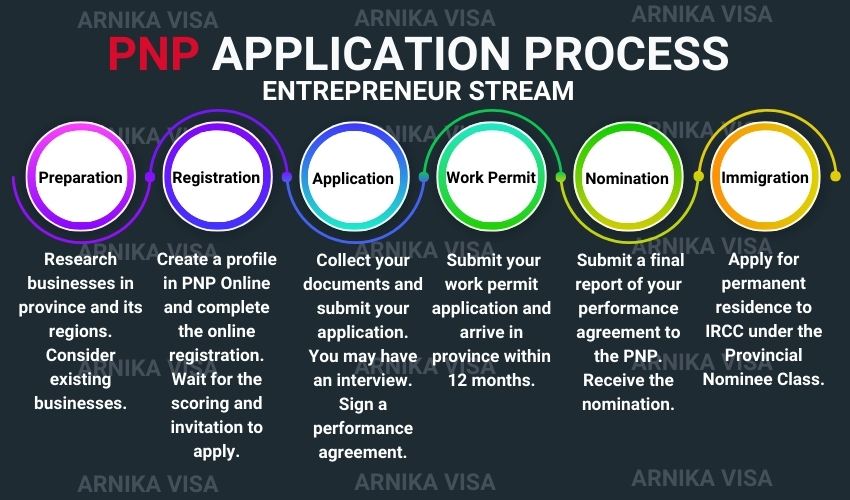
Although each province follows its own procedures, Entrepreneur Immigration Programs generally follow a similar process.
Understanding each stage helps entrepreneurs prepare stronger applications and avoid unnecessary delays.
Step 1 – Evaluate Your Eligibility
The process begins by identifying the province and Entrepreneur Program that best matches your:
- Business experience.
- Investment capacity.
- Industry.
- Long-term immigration goals.
Selecting the right province before investing can significantly improve your chances of success.
Step 2 – Prepare Your Business Proposal
Applicants typically prepare documentation demonstrating that the proposed business is commercially viable.
This usually includes:
- Business plan.
- Financial information.
- Market research.
- Business experience.
- Net worth documentation.
Some provinces may also require additional supporting evidence.
Step 3 – Submit an Expression of Interest (EOI)
Many provinces operate an Expression of Interest (EOI) system.
Applicants submit information about their:
- Business experience.
- Investment.
- Net worth.
- Language ability.
- Proposed business.
Qualified applicants may receive points based on provincial selection criteria.
Higher-ranking candidates are generally more likely to receive invitations.
Step 4 – Receive an Invitation to Apply
Applicants selected through the provincial process receive an invitation to submit a complete application.
At this stage, provinces usually request additional documentation supporting the entrepreneur’s qualifications and proposed business.
Step 5 – Sign a Performance Agreement
Many Entrepreneur Programs require successful applicants to sign a Performance Agreement with the province.
The agreement typically outlines expectations relating to:
- Investment.
- Business establishment.
- Active management.
- Job creation.
- Business performance.
Meeting these commitments is generally necessary before provincial nomination.
Step 6 – Obtain a Work Permit
Many provinces support eligible entrepreneurs in obtaining a temporary work permit so they can relocate to Canada and establish their business.
During this stage, entrepreneurs begin implementing the business plan while complying with the conditions established by the province.
Step 7 – Operate the Business
After arriving in Canada, entrepreneurs actively manage the business while fulfilling the commitments outlined in their Performance Agreement.
This period typically involves:
- Investing funds.
- Hiring employees.
- Growing the business.
- Maintaining compliance with provincial requirements.
Step 8 – Receive Provincial Nomination
Once the entrepreneur successfully fulfills the agreed conditions, the province may issue a nomination for permanent residence.
Provincial nomination represents one of the final stages before applying to Immigration, Refugees and Citizenship Canada (IRCC).
Step 9 – Apply for Permanent Residence
Following provincial nomination, entrepreneurs submit their permanent residence application to the federal government.
IRCC conducts the final assessment before granting permanent residence.
Not every province follows this exact sequence. Some programs have different intake systems, work permit arrangements, and nomination requirements.
How Much Money Do You Need for Entrepreneur Immigration Canada?
There is no single investment amount for Entrepreneur Immigration Canada. The required investment, minimum net worth and business requirements vary by province and stream. For example, current programs may require different levels of investment depending on the location and type of business. Applicants should evaluate the total financial requirement—including investment, working capital, settlement costs and professional fees—rather than focusing only on the minimum investment.
How Immigration Officers Assess Entrepreneur Applications
Entrepreneur Immigration Programs evaluate much more than financial resources.
Immigration officers and provincial authorities assess whether the proposed business is genuine, commercially viable, and capable of contributing to the provincial economy.
During the assessment process, they commonly consider questions such as:
- Does the entrepreneur possess relevant business experience?
- Is the proposed investment realistic?
- Does the business satisfy provincial objectives?
- Is there genuine market demand?
- Are the financial projections credible?
- Will the entrepreneur actively manage the business?
- Can the business reasonably succeed?
- Will the business create economic benefits for the province?
Rather than focusing on a single factor, authorities evaluate the overall credibility of both the applicant and the proposed business.
Applicants who prepare realistic business plans supported by market research and financial evidence generally present stronger applications.
Common Mistakes When Applying for Entrepreneur Immigration Canada
Many entrepreneurs have strong business backgrounds but still encounter difficulties because they misunderstand how Provincial Entrepreneur Programs operate.
Avoiding the following common mistakes can significantly improve both your business strategy and your immigration application.
Choosing the Wrong Province
Many applicants select a province based only on the minimum investment amount.
However, the lowest investment does not necessarily mean the highest chance of success.
Before choosing a province, consider:
- Market demand.
- Business opportunities.
- Industry experience.
- Population.
- Labour availability.
- Provincial immigration requirements.
- Long-term business goals.
Selecting a province that aligns with both your business and immigration objectives usually leads to better outcomes.
Submitting a Weak Business Plan
One of the most common reasons applications become less competitive is a poorly prepared business plan.
A successful business plan should demonstrate:
- Commercial viability.
- Market demand.
- Realistic financial projections.
- Business operations.
- Hiring strategy.
- Growth opportunities.
- Expected economic contribution.
Generic business plans copied from templates rarely satisfy provincial expectations.
Learn how to prepare a stronger application in our Canada Immigration Business Plan guide.
Underestimating Financial Requirements
Many entrepreneurs budget only for the initial investment.
In reality, they should also consider:
- Working capital.
- Commercial rent.
- Equipment.
- Marketing.
- Employee salaries.
- Insurance.
- Professional fees.
- Unexpected operating expenses.
Having sufficient financial resources demonstrates that the business has realistic prospects for long-term success.
Lacking Relevant Business Experience
Provincial Entrepreneur Programs are intended for experienced business owners and senior managers.
Applicants should clearly demonstrate how their previous experience prepares them to successfully operate the proposed Canadian business.
The stronger the connection between your background and your proposed business, the more credible your application becomes.
Failing to Actively Manage the Business
Entrepreneur Immigration Programs are designed for entrepreneurs—not passive investors.
Simply investing money without participating in daily operations generally does not satisfy provincial requirements.
Applicants are expected to play an active role in:
- Strategic planning.
- Financial management.
- Hiring employees.
- Business development.
- Daily operations.
Frequently Asked Questions About Entrepreneur Immigration Canada
Can I Buy an Existing Business for Entrepreneur Immigration Canada?
Yes, many provincial entrepreneur programs allow eligible applicants to buy an existing business, although the requirements vary by province. The purchase must generally be genuine, commercially reasonable and meet the program’s ownership, investment and active-management requirements.
Do I need previous business experience?
Generally, yes. Most Entrepreneur Immigration Programs require applicants to demonstrate previous business ownership or senior management experience.
Specific requirements vary between provinces.
Can my spouse and children accompany me?
Depending on your immigration status and the specific program, eligible family members may accompany you to Canada.
Spouses may qualify for an Open Work Permit, while dependent children may be eligible to attend Canadian schools.
Do I need a business plan?
Yes. A comprehensive business plan is one of the most important supporting documents in most Entrepreneur Immigration applications.
It demonstrates that your proposed business is commercially viable and supports the objectives of the selected provincial program.
How long does the Entrepreneur Immigration process take?
Processing times vary considerably depending on:
- The province.
- Program requirements.
- Application volume.
- Business establishment period.
- Provincial nomination process.
- Federal permanent residence processing.
Entrepreneurs should prepare for a multi-stage process that includes both provincial and federal immigration procedures.
What is the minimum investment for Entrepreneur Immigration Canada?
There is no single minimum investment. Each province and entrepreneur stream establishes its own investment and net worth requirements.
Can I get permanent residence through Entrepreneur Immigration Canada?
Yes. Eligible provincial entrepreneur programs can provide a pathway to permanent residence after the applicant establishes and operates the business and meets the province’s nomination requirements.
What About Canada's Start-Up Visa?
Canada’s Start-Up Visa is a separate federal entrepreneur immigration pathway. However, as of 2026, the program is closed for new applications except for applicants with a valid 2025 commitment certificate who applied by June 30, 2026. IRCC has also announced plans for a new targeted entrepreneur pilot.
Official Government Resources
Related Business Immigration Resources
If you’re considering Entrepreneur Immigration Canada, you may also find these guides helpful:
Need Professional Assistance with Entrepreneur Immigration Canada?
If you’re still comparing Entrepreneur Immigration with other Canadian business immigration pathways, begin with our Canada Business Immigration Guide before deciding which program best supports your business objectives.
At Arnika Visa, our licensed RCIC helps entrepreneurs identify the most suitable Provincial Entrepreneur Program based on their business background, investment capacity, and long-term immigration objectives.
Our services include:
- Assessing eligibility for Provincial Entrepreneur Programs.
- Developing customized business immigration strategies.
- Preparing immigration business plans.
- Reviewing business proposals.
- Assisting with work permit applications where applicable.
- Preparing permanent residence applications following provincial nomination.
- Providing professional representation before Immigration, Refugees and Citizenship Canada (IRCC).
Whether you plan to establish a new business or purchase an existing one, we can help you develop a strategy that supports both your business goals and your Canadian immigration journey.
Book a consultation today to discuss your Entrepreneur Immigration options.
About the Author

Reviewed by Reza Eslami, RCIC (R710241)
Regulated Canadian Immigration Consultant specializing in Canadian business immigration and work permits.
Reza Eslami, RCIC (R710241) is a Regulated Canadian Immigration Consultant (RCIC) and the founder of Arnika Visa, a Canadian immigration consultancy specializing in business immigration, work permits, visitor visas, study permits, and permanent residence applications.