

Canada is one of the world’s most attractive destinations for entrepreneurs looking to establish and grow a business. Its stable economy, business-friendly environment, transparent legal system, skilled workforce, and access to global markets make it an excellent location to start a business in Canada.
Every year, entrepreneurs from around the world choose Canada to start technology companies, professional service firms, manufacturing businesses, retail operations, restaurants, logistics companies, and many other enterprises. In addition to its strong economy, Canada offers business immigration programs that allow eligible entrepreneurs to relocate to Canada and build a successful business.
One of the most common questions foreign entrepreneurs ask is whether they can legally start a business before becoming a Canadian permanent resident.
The answer is yes.
In many situations, foreign nationals can legally establish and own a Canadian business without first obtaining permanent residence. However, owning a business is different from having authorization to work in Canada. If your goal is to relocate and actively manage your company, you must also qualify under an appropriate Canadian immigration program.
Depending on your business background and long-term objectives, programs such as the C11 Work Permit, Intra Company Transfer (ICT) Work Permit, and Provincial Entrepreneur Immigration Programs may provide pathways to establish and operate your business in Canada. Successfully managing your business may later support an application for Canadian permanent residence through an eligible immigration program.
Whether you are launching your first company or expanding an established international business into Canada, careful planning is essential. Choosing the right business structure, preparing a realistic business plan, understanding legal obligations, and selecting the appropriate immigration pathway can significantly improve your chances of long-term success.
In this comprehensive guide, you’ll learn how to start a business in Canada as a foreign entrepreneur, including legal requirements, business registration, financing, taxation, immigration options, common mistakes to avoid, and practical steps for building a successful Canadian business.

Can Foreigners Start a Business in Canada?
Yes.
Foreign nationals are generally permitted to establish and own businesses in Canada.
Unlike many countries that restrict foreign ownership, Canada allows international entrepreneurs to incorporate companies, purchase shares, establish partnerships, and invest in Canadian businesses, subject to federal and provincial legislation.
Many foreign entrepreneurs successfully establish businesses in Canada while continuing to reside abroad during the initial stages of the project. Others create their Canadian company before applying for a work permit or expanding their existing international business into the Canadian market.
Depending on your business objectives, you may choose to:
- Incorporate a new Canadian company.
- Open a branch or subsidiary of your foreign business.
- Form a partnership with Canadian residents.
- Establish a professional practice.
- Launch an online business serving Canadian customers.
- Develop a startup focused on innovation or technology.
However, establishing a business and having permission to actively work in Canada are two separate legal matters.
If you plan to relocate to Canada and manage your company on a day-to-day basis, you will normally require a work permit or another form of immigration status that authorizes you to work.
For this reason, many entrepreneurs begin by developing a comprehensive business strategy before selecting the immigration pathway that best aligns with their business objectives. If you’re still deciding which pathway is right for you, our Canada Business Immigration Guide compares all temporary and permanent business immigration options available to foreign entrepreneurs.
If you’re still comparing your options, our Canada Business Immigration Guide explains the temporary and permanent immigration pathways available to entrepreneurs, investors, and international business owners.

Do You Need Permanent Residence to Start a Business in Canada?
No.
Canadian permanent residence is not a legal requirement for starting or owning a business.
Many successful Canadian companies have foreign shareholders, international investors, or overseas parent companies.
Depending on the province and the business structure you choose, you may be able to:
- Incorporate a Canadian corporation.
- Register a federal corporation.
- Become a shareholder.
- Establish a partnership.
- Open a subsidiary of your foreign company.
- Invest in an existing Canadian business.
Although ownership is generally permitted, entrepreneurs who intend to physically work in Canada must ensure that they also hold the appropriate immigration authorization.
This distinction is often misunderstood.
Many people believe that owning a company automatically gives them the right to work in Canada. In reality, business ownership and immigration status are governed by different laws.
For example, a foreign entrepreneur may legally establish a Canadian corporation from outside Canada while still requiring a work permit before relocating to operate that business in person.
Understanding this distinction before investing can help entrepreneurs avoid costly immigration and business planning mistakes.
Can Starting a Business Lead to Permanent Residence?
This is one of the most frequently asked questions among international entrepreneurs.
The answer is:
Not directly.
Canada does not operate a citizenship-by-investment or permanent residence-by-investment program.
Simply registering a company or investing money into a Canadian business does not automatically qualify someone for permanent residence.
Instead, starting a business may become an important part of a long-term immigration strategy.
For many entrepreneurs, the process typically follows these stages:
- Establish a Canadian business.
- Obtain an appropriate work permit.
- Actively manage the business.
- Meet the requirements of the selected immigration program.
- Become eligible for permanent residence through an available pathway.
Whether this strategy is successful depends on many factors, including:
- The immigration program selected.
- Your management experience.
- Language proficiency.
- Business performance.
- Financial resources.
- Provincial requirements.
- Overall immigration eligibility.
Rather than viewing business ownership as a direct route to permanent residence, entrepreneurs should consider it part of a carefully planned immigration strategy.
Business Immigration Pathways for Foreign Entrepreneurs
Canada offers several business immigration pathways that may allow eligible entrepreneurs to establish and operate businesses while pursuing their long-term immigration goals.
Choosing the most appropriate pathway depends on factors such as your business background, investment capacity, ownership structure, and long-term objectives.
C11 Work Permit
The C11 Work Permit is one of the most popular options for entrepreneurs starting a new business in Canada.
This LMIA-exempt work permit allows eligible entrepreneurs to establish or purchase a business if they can demonstrate that it will provide a significant economic, social, or cultural benefit to Canada.
Applicants generally need to demonstrate:
- Active involvement in managing the business.
- A realistic business plan.
- Sufficient financial resources.
- Commercial viability.
- Significant benefit to Canada.
For many entrepreneurs launching a new company, the C11 pathway offers an opportunity to relocate to Canada while building their business. Learn more about eligibility, significant benefit requirements, and the application process in our C11 Work Permit Canada guide.
Intra Company Transfer (ICT) Work Permit
Entrepreneurs who already own an established business outside Canada may qualify under the Intra Company Transfer (ICT) Work Permit by expanding their operations into Canada.
Rather than creating an unrelated business, ICT applicants establish a Canadian branch, subsidiary, or affiliate connected to their existing foreign company.
This pathway is designed for international business expansion and is particularly attractive for entrepreneurs seeking to grow their global operations. Read our Intra Company Transfer Canada guide to determine whether expanding your existing company is a better option than starting a completely new Canadian business.
Provincial Entrepreneur Immigration Programs
Several Canadian provinces operate entrepreneur streams through their Provincial Nominee Programs (PNPs).
These programs are designed to attract experienced business owners who are willing to invest in and actively manage businesses within a specific province.
Although each province establishes its own eligibility criteria, applicants are generally expected to:
- Invest in a qualifying business.
- Actively manage daily operations.
- Meet minimum investment thresholds.
- Create employment opportunities.
- Fulfill the conditions of a performance agreement.
Because every province has different investment requirements and eligibility criteria, entrepreneurs should carefully compare the available options before making an investment decision. Our Entrepreneur Immigration Canada guide explains how Provincial Entrepreneur Programs work across Canada.
Starting a Business vs. Buying an Existing Business
One of the first decisions entrepreneurs must make is whether to build a new business from the ground up or purchase an existing Canadian business.
Both options can support Canadian business immigration, but each offers different opportunities, challenges, and levels of risk.
Choosing the right approach depends on your experience, investment capacity, business objectives, and long-term immigration strategy.
Starting a New Business
Launching a new business allows entrepreneurs to build a company that reflects their own vision, experience, and long-term goals.
Some of the advantages include:
- Complete control over business operations.
- Freedom to develop your own brand.
- Flexible business model.
- Opportunity to introduce innovative products or services.
- Modern technology and operational systems.
- Ability to build the company according to your own management style.
However, new businesses also face challenges during the early stages, including:
- Building a customer base.
- Developing brand recognition.
- Generating consistent revenue.
- Recruiting employees.
- Managing startup costs.
For many entrepreneurs, a comprehensive business plan becomes essential for demonstrating that the proposed business is commercially viable.
Buying an Existing Business
Purchasing an existing business may reduce some of the uncertainty associated with launching a completely new company.
An established business often provides:
- Existing customers.
- Proven revenue.
- Experienced employees.
- Operational systems.
- Supplier relationships.
- Established reputation.
- Historical financial records.
However, buyers should carefully evaluate the business before completing the purchase.
A successful acquisition requires proper due diligence to identify financial, legal, operational, and commercial risks. If you’re considering purchasing an established company instead of building one from the ground up, read our Buy a Business in Canada guide to understand the acquisition process, due diligence, and immigration considerations.
How to Choose the Right Business
Choosing the right business is often more important than choosing the right immigration program.
Immigration officers want to see that your proposed business is commercially realistic and that you possess the knowledge and experience necessary to operate it successfully.
Before launching a new business, consider the following factors.
Your Professional Experience
The strongest business immigration applications are usually supported by relevant business or management experience.
If your background aligns with the proposed business, immigration officers are more likely to view your application as credible.
For example, someone with years of experience managing a logistics company may have a stronger case for launching a transportation business than entering an unfamiliar industry.
Market Demand
Every successful business solves a problem or meets a market need.
Before investing, research:
- Customer demand.
- Industry trends.
- Competition.
- Pricing.
- Local demographics.
- Purchasing behaviour.
Reliable market research strengthens both your business strategy and your immigration application.
Investment Capacity
Choose a business that matches your available financial resources.
Remember that your budget should cover much more than incorporation costs.
You should also consider:
- Equipment.
- Inventory.
- Commercial rent.
- Professional fees.
- Marketing.
- Working capital.
- Employee salaries.
- Unexpected operating expenses.
Careful financial planning demonstrates that the business has realistic prospects for long-term success.
Growth Potential
Immigration officers often evaluate whether the business has realistic opportunities for future growth.
Businesses with the potential to expand operations, hire employees, increase revenue, or introduce innovative products generally present stronger long-term business cases.
Rather than focusing only on immediate profits, entrepreneurs should consider how the business may develop over the next several years.
Choosing the Right Province
Canada’s provinces offer different economic opportunities, labour markets, business costs, and immigration programs.
Selecting the right province can significantly influence both the success of your business and your long-term immigration strategy.
Factors to consider include:
- Population growth.
- Local demand.
- Industry concentration.
- Commercial rental costs.
- Availability of skilled workers.
- Provincial taxes.
- Transportation infrastructure.
- Provincial Entrepreneur Programs.
Some industries perform better in certain regions due to local market conditions and economic activity.
Entrepreneurs should evaluate both business opportunities and provincial immigration requirements before deciding where to establish their company.
Choosing the Right Business Structure
One of the first legal decisions entrepreneurs make is selecting the appropriate business structure.
The most suitable option depends on factors such as ownership, liability, taxation, future investment plans, and long-term business objectives.
Sole Proprietorship
A sole proprietorship is the simplest business structure.
The owner controls the business directly and reports business income on their personal tax return.
Advantages include:
- Simple registration.
- Lower administrative costs.
- Easy management.
However, the owner is personally responsible for the business’s debts and obligations.
Partnership
A partnership allows two or more individuals or businesses to operate together.
Responsibilities, profits, and liabilities are generally shared in accordance with a partnership agreement.
This structure may be appropriate for entrepreneurs working with Canadian partners or other investors.
Corporation
Many foreign entrepreneurs choose to incorporate their Canadian business.
A corporation is a separate legal entity that may provide:
- Limited liability protection.
- Greater credibility.
- Easier access to financing.
- Opportunities for future expansion.
- Flexible ownership structure.
The appropriate corporate structure depends on the entrepreneur’s business objectives and provincial requirements.
Professional legal and accounting advice is recommended before selecting a business structure.
How Much Money Do You Need to Start a Business in Canada?
There is no single investment amount required to establish a business in Canada.
The amount depends on several factors, including:
- Industry.
- Business model.
- Province.
- Commercial location.
- Equipment requirements.
- Staffing needs.
- Marketing expenses.
- Working capital.
For example, an online consulting business may require relatively little startup capital, while a manufacturing company or restaurant may require a substantially larger investment.
Entrepreneurs should prepare a realistic financial plan that includes both startup costs and sufficient operating capital for the first year of business.
Rather than focusing solely on the initial investment, immigration officers often assess whether applicants have sufficient financial resources to successfully establish and sustain the business. A professionally prepared Canada Immigration Business Plan demonstrates that your financial projections are realistic and supported by credible assumptions.
Industries That May Face Greater Immigration Scrutiny
Canadian immigration authorities do not publish a list of approved or prohibited business sectors.
However, certain business proposals may receive greater scrutiny during the immigration assessment process.
Examples include:
- Businesses with little evidence of market demand.
- Passive investment businesses where the owner has limited involvement.
- Businesses created primarily to support an immigration application.
- Companies with unrealistic financial projections.
- Businesses lacking a clear competitive advantage.
- Ventures that cannot reasonably support the proposed investment.
Applicants should demonstrate that the proposed business serves a genuine commercial purpose and has realistic prospects for long-term success.
A well-researched business plan supported by market analysis, financial projections, and operational planning can significantly strengthen the credibility of the application.

Writing a Business Plan
A well-prepared business plan is one of the most important foundations of a successful business. It serves as a roadmap for your operations and, for many business immigration pathways, becomes a key document supporting your immigration application.
A strong business plan should explain:
- Your business concept.
- Target market.
- Competitive analysis.
- Marketing strategy.
- Operational plan.
- Financial projections.
- Hiring plans.
- Growth strategy.
- Expected contribution to the Canadian economy.
For entrepreneurs applying through programs such as the C11 Work Permit, Intra Company Transfer (ICT), or Provincial Entrepreneur Immigration Programs, the business plan should address both commercial viability and immigration requirements.
Rather than using a generic template, your business plan should be tailored to your proposed business, your chosen immigration pathway, and your long-term business objectives. Our Canada Immigration Business Plan guide explains exactly what immigration officers expect to see and how to prepare a stronger application.
Registering Your Business in Canada
After choosing your business structure, the next step is registering your business.
The registration process varies depending on whether you incorporate federally or provincially and on the province where your business will operate.
In general, registration involves:
- Choosing a business name.
- Conducting a name search (where required).
- Registering the business or incorporating the company.
- Obtaining a Business Number (BN) from the Canada Revenue Agency (CRA).
- Registering for GST/HST if applicable.
- Obtaining provincial registrations where required.
Some businesses may also need additional municipal registrations depending on their activities.
Before registering your company, ensure that your chosen business structure aligns with both your commercial objectives and your immigration strategy.
Business Licences and Permits
Registering a company does not necessarily authorize you to begin operating.
Many businesses must obtain additional licences or permits before offering products or services.
Requirements depend on factors such as:
- Industry.
- Province.
- Municipality.
- Professional regulations.
- Health and safety requirements.
- Environmental regulations.
Examples include:
- Restaurant licences.
- Construction permits.
- Professional licences.
- Import/export permits.
- Transportation licences.
- Childcare licences.
- Food handling permits.
Entrepreneurs should verify all licensing requirements before beginning operations.
Failure to obtain the necessary licences may delay business operations and create compliance issues.
Opening a Canadian Business Bank Account
Separating personal and business finances is an important step in operating a professional business.
Most Canadian financial institutions offer business banking services tailored to corporations, partnerships, and sole proprietorships.
A business account may be used for:
- Receiving customer payments.
- Paying suppliers.
- Managing payroll.
- Paying taxes.
- Monitoring cash flow.
- Building business credit.
The documentation required varies depending on the financial institution but commonly includes:
- Incorporation documents.
- Business registration.
- Identification.
- Shareholder information.
- Business Number (BN).
Some banks may also request additional documentation from non-resident business owners.
Understanding Canadian Business Taxes
Every entrepreneur should understand the basic tax obligations associated with operating a business in Canada.
Depending on the business structure and level of activity, obligations may include:
- Corporate income tax.
- Personal income tax.
- Goods and Services Tax (GST) / Harmonized Sales Tax (HST).
- Payroll deductions.
- Provincial taxes.
- Employer contributions.
Tax obligations vary according to the province, business structure, annual revenue, and the nature of the business.
Working with a qualified accountant can help ensure compliance while optimizing your business’s financial management.
Hiring Employees
As your business grows, you may need to recruit employees to support daily operations.
Building a capable workforce can also strengthen your business by improving customer service, operational efficiency, and long-term growth.
Depending on the business, entrepreneurs may hire:
- Administrative staff.
- Sales personnel.
- Technical specialists.
- Skilled trades.
- Marketing professionals.
- Customer service representatives.
- Managers.
Employers are responsible for complying with Canadian employment standards, payroll regulations, workplace safety requirements, and applicable labour laws.
For some business immigration programs, planned job creation may also support the overall strength of the immigration application.
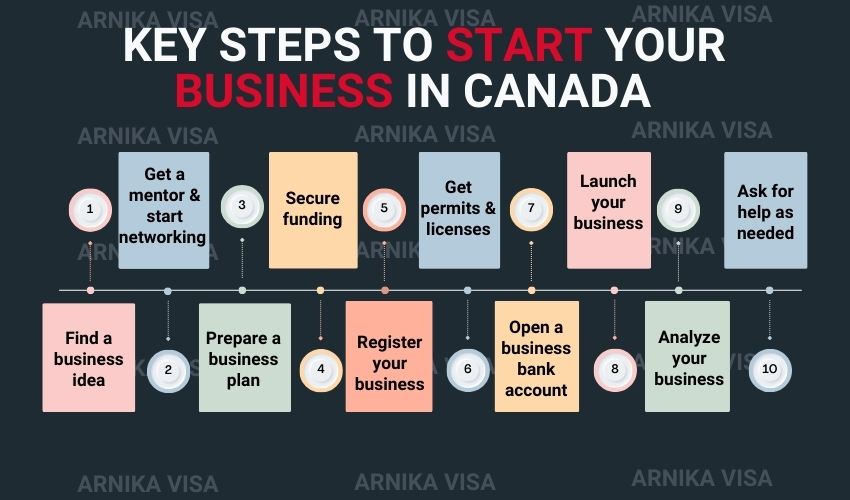
Step-by-Step Guide to Starting a Business in Canada
Although every business is unique, most entrepreneurs follow a similar process when establishing a company in Canada.
Step 1 – Identify Your Business Opportunity
Begin by identifying a business that aligns with your professional experience, investment capacity, and long-term objectives.
Successful businesses solve genuine market problems while offering sustainable growth opportunities.
Step 2 – Conduct Market Research
Research your industry carefully before investing.
Evaluate:
- Customer demand.
- Competitors.
- Pricing.
- Market trends.
- Local demographics.
- Industry growth.
Reliable market research provides the foundation for both your business strategy and your immigration business plan.
Step 3 – Prepare Your Business Plan
Develop a comprehensive business plan explaining how your company will operate, generate revenue, manage expenses, and grow over time.
This document is particularly important for entrepreneurs pursuing Canadian business immigration.
Step 4 – Choose Your Business Structure
Decide whether a sole proprietorship, partnership, or corporation best supports your business objectives.
Professional legal and accounting advice may be beneficial before making this decision.
Step 5 – Register Your Business
Register or incorporate your business with the appropriate federal or provincial authority.
Complete any additional tax registrations required before commencing operations.
Step 6 – Obtain Required Licences and Permits
Before opening your doors, ensure that all required federal, provincial, and municipal licences have been obtained.
Compliance at this stage helps avoid delays and regulatory issues.
Step 7 – Secure Financing and Open Business Accounts
Arrange sufficient capital to support startup costs and early operations.
Open a dedicated business bank account to manage finances professionally.
Step 8 – Launch and Grow Your Business
Once your business is operational, focus on delivering quality products or services, building your customer base, hiring employees where appropriate, and achieving the objectives outlined in your business plan.
For entrepreneurs pursuing Canadian business immigration, successfully operating the business is often an important step toward meeting future immigration requirements.
Common Mistakes When Starting a Business in Canada
Starting a business in Canada can create exciting opportunities, but many entrepreneurs make avoidable mistakes that can affect both the success of the business and their immigration plans.
Understanding these common pitfalls can help you prepare a stronger business strategy from the beginning.
Starting a Business Without Market Research
One of the most common mistakes is launching a business without understanding the Canadian market.
Every successful business should be based on reliable research rather than assumptions.
Before investing, entrepreneurs should evaluate:
- Customer demand.
- Local competition.
- Industry trends.
- Pricing strategies.
- Regional economic conditions.
Businesses supported by thorough market research are generally more likely to achieve long-term success.
Choosing the Wrong Immigration Pathway
Many entrepreneurs establish a business before determining which immigration program best supports their objectives.
Selecting the wrong pathway may result in unnecessary delays, additional costs, or applications that do not align with the entrepreneur’s long-term goals.
Before investing, compare the available options, including the C11 Work Permit, Intra Company Transfer (ICT), and Provincial Entrepreneur Programs. Our Canada Business Immigration Guide provides an overview of every business immigration pathway currently available in Canada.
Preparing a Weak Business Plan
A business plan is more than a planning document.
For many business immigration applications, it is one of the most important pieces of supporting evidence.
Generic templates often fail to demonstrate:
- Commercial viability.
- Market demand.
- Financial sustainability.
- Hiring strategy.
- Growth objectives.
- Expected benefit to Canada.
A customized business plan supported by credible market research and realistic financial projections significantly strengthens both your business strategy and your immigration application.
Learn what immigration officers expect by reading our Canada Immigration Business Plan guide.
Underestimating Startup Costs
Many entrepreneurs focus only on incorporation costs.
In reality, startup expenses often include:
- Commercial rent.
- Equipment.
- Marketing.
- Professional services.
- Insurance.
- Employee salaries.
- Inventory.
- Working capital.
Preparing realistic financial projections helps reduce business risk during the first year of operation.
Trying to Manage Every Aspect Alone
Launching a business requires expertise in many different areas.
Entrepreneurs often benefit from working with:
- Accountants.
- Business lawyers.
- Immigration professionals.
- Financial advisors.
- Commercial bankers.
Building the right professional team can help reduce legal, financial, and operational risks while allowing entrepreneurs to focus on growing their business.
How Immigration Officers Assess New Businesses
For business immigration applications, immigration officers evaluate far more than the fact that a company has been incorporated.
They assess whether the proposed business is genuine, commercially viable, and consistent with the objectives of the selected immigration program.
During the assessment process, officers commonly consider questions such as:
- Is the business commercially realistic?
- Does the entrepreneur have relevant business experience?
- Is there genuine market demand?
- Are the financial projections realistic?
- Does the entrepreneur have sufficient financial resources?
- Will the entrepreneur actively manage the business?
- Can the business reasonably succeed in Canada?
- Will the business contribute to Canada’s economy?
Rather than focusing on a single factor, immigration officers evaluate the overall credibility of the business proposal and the supporting documentation.
A strong application demonstrates that the entrepreneur has carefully planned every aspect of the business before seeking immigration approval.
Frequently Asked Questions About Starting a Business in Canada
Can I start a business in Canada without being a permanent resident?
Yes.
Foreign nationals may generally establish and own businesses in Canada without first becoming permanent residents.
However, if you intend to relocate and actively manage the business, you will normally require an appropriate immigration status that authorizes you to work in Canada.
Can I start a business while living outside Canada?
Yes.
Many entrepreneurs establish Canadian corporations before relocating.
Depending on the immigration pathway, they may later apply for a work permit that allows them to manage the business in Canada.
Can starting a business lead to permanent residence?
Not automatically.
Starting a business may support certain business immigration pathways that can eventually lead to permanent residence, provided all program requirements are met.
How much money do I need to start a business?
There is no minimum investment amount that applies to every business.
Startup costs depend on:
- Industry.
- Province.
- Business model.
- Equipment.
- Employees.
- Commercial location.
- Operating expenses.
A detailed financial plan helps determine the amount of capital required.
Should I incorporate federally or provincially?
The most appropriate option depends on where your business will operate and your long-term business objectives.
Many entrepreneurs seek legal and accounting advice before deciding which corporate structure best supports their plans.
Do I need a business plan?
For many entrepreneurs, yes.
A business plan helps guide business decisions and is often an important supporting document for business immigration applications.
Can my spouse and children accompany me?
Depending on the immigration program, eligible spouses and dependent children may accompany you to Canada.
Spouses may qualify for an Open Work Permit, while dependent children may be eligible to attend Canadian schools.
Should I hire professional advisors before starting a business?
Working with experienced accountants, lawyers, and immigration professionals can help entrepreneurs avoid costly mistakes while establishing and growing their Canadian business.
Related Business Immigration Resources
If you’re planning to establish a business in Canada, you may also find these guides helpful:
Need Professional Assistance Starting a Business in Canada?
Starting a business involves much more than registering a company. Choosing the right immigration pathway, preparing a strong business plan, and developing a realistic business strategy are equally important. If you’re still exploring your options, start with our Canada Business Immigration Guide before booking a consultation.
At Arnika Visa, our licensed RCIC assists entrepreneurs and business owners in developing business immigration strategies tailored to their individual goals.
Our services include:
- Assessing business immigration eligibility.
- Advising on suitable business immigration pathways.
- Preparing immigration business plans.
- Supporting C11 Work Permit applications.
- Assisting with ICT Work Permit strategies.
- Guiding entrepreneurs through Provincial Entrepreneur Immigration Programs.
- Providing professional representation before Immigration, Refugees and Citizenship Canada (IRCC).
Whether you’re launching a new business, expanding an existing international company, or exploring Canadian business immigration options, we can help you develop a strategy that supports both your business objectives and your long-term immigration plans.
Book a consultation today to discuss your Canadian business immigration strategy.
About the Author

Reza Eslami is a Regulated Canadian Immigration Consultant (RCIC) specializing in Canadian business immigration, work permits, permanent residence, and corporate expansion strategies. He advises entrepreneurs, investors, and international business owners on establishing businesses in Canada through pathways such as the C11 Work Permit, Intra Company Transfer (ICT), and Provincial Entrepreneur Immigration Programs.